
by admin
Share
by admin
Share
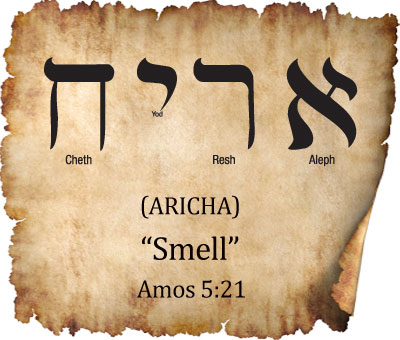
HEBREW WORD STUDY –SMELL – ‘ARICHA אריח
Amos 5:21, “I hate, I despise your feast days, and I will not smell in your solemn assemblies.”
 For the ancient Hebrews, their vehicle of worship was to diffuse fragrances such as frankincense and Myrrh which creates a euphoric feeling that people misinterpreted as the presence of God. Today our vehicle for worship is music which can create a similar euphoric feeling that some people mistake for the presence of God. The idea of the music and/or fragrances is to prepare one for worship. That is to create a feeling of relaxation so one can focus on God and worship God more freely, not to create a feeling of the presence of God.
The word smell in Hebrew is ‘aricha which comes from the root word ruch. Many of our modern translations render the word ‘aricha (smell) as a pungent or disgusting odor to fit their interpretation of the context. Yet ruch is the same word used for the Holy Spirit. Ruch is often rendered as wind, spirit or a pleasant fragrance. What God is saying when He says: “I will not smell” is that he will not smell their fragrances because of their insincerity in worship. It is not that the smell is pungent, it is just used wrongly. He will not recognize their attempts to enter into worship. Thus what euphoric feeling the people have is just the natural result of the fragrances (or music) and not the presence of God. What is even more disgusting is that people actually believed those fragrances would summon the presence of God, not unlike some people who believe our music will summon the presence of God. We can’t summon God’s presence like some pagan ritual. His presence is always with us, we just have to relax and focus on Him which is where the fragrances and music come in.
So let’s just put this in a modern context as we approach this Easter season. “I hate, I despise your feast days, and I will not smell (listen to your music) in your solemn assemblies (worship services).” Amos is saying that this is God’s feelings about our worship when we perform it to impress others with our piety, or just to get that euphoric feeling or to even do it to bribe God to answer a prayer (I worshipped you so now you have to do this for me). The Easter season is a time to relax, enjoy the spring weather, and focus on the great Sacrifice that Jesus made for us. The more we focus on Him the more we feel His presence. If fragrances or music helps you to focus, well God create it for that purpose. But, let Him provide that euphoric feeling.
STAY IN THE LOOP
Subscribe to our free newsletter.
Leave A Comment

Hebrew Word Study – A Passion – B’ir – Beth Ayin Yod Resh Song of Solomon 3:3, “The watchmen that go about the city found me: Saw ye him who my soul loveth?” “Ich bin ein Berliner” John F. Kennedy, June 26. 1963. Translation, “I am a jelly filled donut.” There is an urban legend

HEBREW WORD STUDY – (HEARING GOD’S) VOICE – QAVAL קול Exodus 19:5: Now therefore if you will obey my voice indeed and keep my commandments, Then you will be a peculiar treasure unto me above all the people, for all the earth is mine.” What caught my attention in this verse is the thought that
-
Hebrew Word Study – A Sensitive Nature – Pathah – Pei Taw Hei פתה Psalms 116:6: “The Lord preserves the simple, I was brought low and He helped me.” Hebrew Word Study – A Sensitive Nature – Pathah – Pei Taw Hei Psalms 116:6: “The Lord preserves the simple, I was brought low and He
WORD STUDY – ABBA אבא Mark 14:35-36: “And he went forward a little, and fell on the ground, and prayed that, if it were possible, the hour might pass from him. And he said, Abba, Father, all things are possible unto thee; take away this cup from me: nevertheless not what I will, but what