by admin
Share
by admin
Share

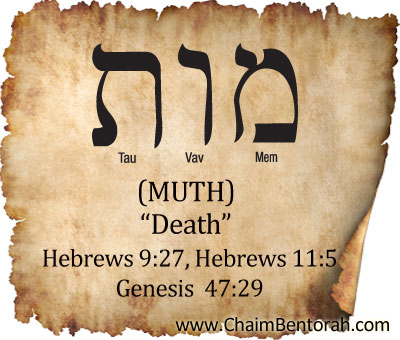
ARAMAIC WORD STUDY – DEATH MUTH – מות
Hebrews 9:27: “And as it is appointed unto men once to die, but after this the judgment:”
Hebrews 11:5: “By faith Enoch was translated that he should not see death
Genesis 47:29: “And the time drew nigh that Israel must die:”
 I was reading something very interesting in the Midrash Rabbah this evening. Rabbi Shimon Ben Lakish showed in that in the Hebrew Genesis 47:29 which speaks of the passing of Jacob that the passage does not say; “Israel drew near to die” but the literal rendering in Hebrew is “the days of Israel drew near to die.” In other words, Rabbi Shimon is saying that the righteous do not die only the days that they live dies. What did he mean?
I remember as a child I was troubled by these verses in the book of Hebrews. For one thing, I was told by our preachers that whole bunches of us would get raptured and never see death. If that is the case what about this appointment that we have to die business? Well, for one thing, the word death in both Aramaic and Hebrew is muth which could mean either physical or spiritual death or possibly both.
Back in March I did a study on Hebrews 9:27 and showed in the Aramaic that it reads as: “One time it is established they would be condemned to death and then out of that (condemnation) after their death the judgment. The word appoint in Aramaic is sum which means really means to establish. Here’s the key, the word for death is prefixed with a Nun which puts that word into an Ithpeel which is similar to the Hebrew Hithpael making it reflexive. This is a death that we are responsible for. God is responsible for the physical death of our bodies, but the death of our spirit is on us. God provided a way for our spirits to not suffer that “second death” (Revelations 20:14). If it does it is our own fault. God doesn’t send people to hell, we send ourselves.
The Talmud teaches that the greatest form of uncleanliness is death. The Sages explain that this is because it is the physical body that is responsible for dragging our poor spirits down into sin and making our spirits unclean. From a Christian view, Jesus died to clean up our spirits, not our physical bodies. The physical body is still going to crave sin and drag our spirits along with it even after Jesus cleans it up.
Thinking in a Jewish mindset Paul was saying that it is established unto man that at one time we are all spiritually dead or spiritually condemned then out of that condemnation we will be judged when we physically die.
Yet in Hebrews 2:3 we find Paul speaking of an escape clause. “How shall we escape if we neglect so great salvation.” It is our spirits that live for eternity and is made pure through the sacrifice of Jesus.
The word death or muth simply means an end or a conclusion not necessarily the end of life. David saw death only as the opportunity to be closer to the God He loved. Death in Hebrew is spelled Mem – revelation that comes from the next letter Vav which connects us to heaven to reveal to us the Taw or the truth.
In my case, God can get rid of this old body anytime He wants for all I care, my spirit is attached to Him and not this body. But as long as He has me stuck in this old shell, then I will use it to make others aware of is His “so great salvation.”
STAY IN THE LOOP
Subscribe to our free newsletter.
Leave A Comment
Hebrew Word Study – A Passion – B’ir – Beth Ayin Yod Resh Song of Solomon 3:3, “The watchmen that go about the city found me: Saw ye him who my soul loveth?” “Ich bin ein Berliner” John F. Kennedy, June 26. 1963. Translation, “I am a jelly filled donut.” There is an urban legend

HEBREW WORD STUDY – (HEARING GOD’S) VOICE – QAVAL קול Exodus 19:5: Now therefore if you will obey my voice indeed and keep my commandments, Then you will be a peculiar treasure unto me above all the people, for all the earth is mine.” What caught my attention in this verse is the thought that
-
Hebrew Word Study – A Sensitive Nature – Pathah – Pei Taw Hei פתה Psalms 116:6: “The Lord preserves the simple, I was brought low and He helped me.” Hebrew Word Study – A Sensitive Nature – Pathah – Pei Taw Hei Psalms 116:6: “The Lord preserves the simple, I was brought low and He
WORD STUDY – ABBA אבא Mark 14:35-36: “And he went forward a little, and fell on the ground, and prayed that, if it were possible, the hour might pass from him. And he said, Abba, Father, all things are possible unto thee; take away this cup from me: nevertheless not what I will, but what