
by admin
Share
by admin
Share
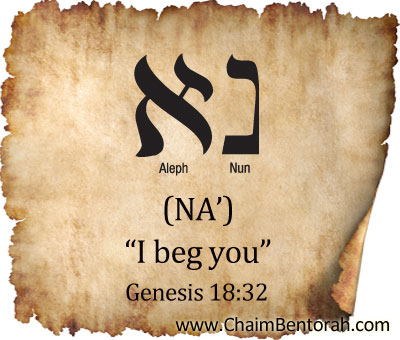
HEBREW WORD STUDY – I BEG YOU – NA’ נא
Genesis 18:32: “And he said, Oh let not the Lord be angry, and I will speak yet but this once: Peradventure ten shall be found there. And he said, I will not destroy [it] for ten’s sake.”
 I suppose most of us have heard a sermon or two on this story of the destruction of Sodom and how Abraham tried to bargain with God starting off by asking if there were fifty righteous would God spare the city. He finally managed to haggle God down to ten righteous and God said for the sake of ten He would not destroy Sodom. Then with a sigh, the preacher would say; “Alas, God could not even find ten righteous in Sodom.” There the message seems to end.
Is there not another message, possibly a more relevant message that is right before our eyes and we fail to see it. At least I failed to see it after all my years of study. It was not until I was reading it Jewish literature, Rashi to be precise, did I realize a far greater message that we overlooked. It took a Medieval Jewish scholar to teach this old Baptist a very important lesson in Evangelism.
Rashi made a point of distinction between Noah and Abraham. Noah preached a message of repentance to the world but Abraham prayed and pleaded with God to spare Sodom. Did any soul winners ever wonder what was going on in Abraham’s mind when he bargained with God? The Bible does not say God got angry with Abraham’s continued plea, it was Abraham who thought he was wearing on God’s patience. I mean if he really was bugging God, God would have shut him down without letting him continue his rant. Yet, even though Abraham knew he was being a pest, he didn’t care because he cared more for the people of Sodom than making a fool of himself. That little Hebrew word na’ says it all. Most translations tend to overlook the emotional context and render this as a polite, “May the Lord” or “Let not the Lord.” Yet, na’ is an ancient colloquial expression that is a plea or a cry for mercy. It is hard to translate to capture the emotion but it is an earnest, passionate cry – “Pleeeeeeeeeese!!!!!” He was literally begging God not to destroy Sodom.
Too many Christians treat evangelism as an obligation, a duty like it was for Noah who entered the ark without one convert after 120 years. People are not fooled, they know you are trying to convert them to get another notch on your belt, to be the number one soul winner in your group. Why do you think Hollywood makes fun of evangelicals, they see through your phony act. They know you don’t care a snap for them. Like Noah, you will preach repentance because it is your duty and as a result, you will have few converts.
But if you passionately pray for the lost, like Abraham, there will be a passion arising in you and when you share the message of God’s salvation from your heart and not from your sense of duty when you really do care for the lost then you will see the converts. For the Holy Spirit dwells in your heart, not your mind. When you share your mind, like Noah, people will hear you. When you share your heart like Abraham, people will hear the Holy Spirit. In Genesis 18 Abraham gives us the secret to acquiring this passion, it is called prayer. The more you pray for the lost, the more you will long to reach the lost. We do not need prayer to persuade God, He is all for reaching the lost. We need prayer to persuade ourselves.
STAY IN THE LOOP
Subscribe to our free newsletter.
Leave A Comment
Hebrew Word Study – A Passion – B’ir – Beth Ayin Yod Resh Song of Solomon 3:3, “The watchmen that go about the city found me: Saw ye him who my soul loveth?” “Ich bin ein Berliner” John F. Kennedy, June 26. 1963. Translation, “I am a jelly filled donut.” There is an urban legend

HEBREW WORD STUDY – (HEARING GOD’S) VOICE – QAVAL קול Exodus 19:5: Now therefore if you will obey my voice indeed and keep my commandments, Then you will be a peculiar treasure unto me above all the people, for all the earth is mine.” What caught my attention in this verse is the thought that
-
Hebrew Word Study – A Sensitive Nature – Pathah – Pei Taw Hei פתה Psalms 116:6: “The Lord preserves the simple, I was brought low and He helped me.” Hebrew Word Study – A Sensitive Nature – Pathah – Pei Taw Hei Psalms 116:6: “The Lord preserves the simple, I was brought low and He
WORD STUDY – ABBA אבא Mark 14:35-36: “And he went forward a little, and fell on the ground, and prayed that, if it were possible, the hour might pass from him. And he said, Abba, Father, all things are possible unto thee; take away this cup from me: nevertheless not what I will, but what