
by admin
Share
by admin
Share

HEBREW WORD STUDY – HIS COUNTENANCE – PANI פני
Numbers 6:26: “The Lord lift up His countenance upon thee and give thee peace.”
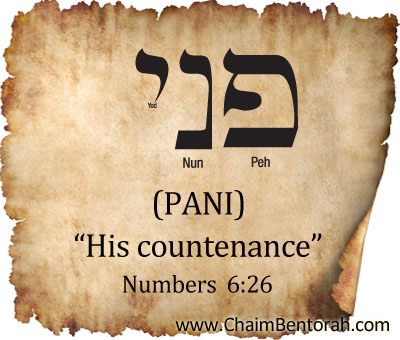 This blessing is used so much in many traditional churches that we never stop to think what it is the priest, pastor of a worship leader is really saying. What does it mean to ask the Lord to lift His countenance unto you? Many modern English translations render it as “May He the turn His face to you.” So render it as showing favor, being good to you or just facing toward you.
In oriental culture, a mere peasant or servant was not permitted to look a king in the eye. When in the presence of the king one must look down and not at his face. Only the closest and most trusted servants were allowed to look the king in the eyes. This is not only to show respect but to keep the servants from becoming too familiar with the king. It was a way of exercising control, keeping a person in his place so to speak. It was to keep the mystique of the king alive. Your facial expressions and your eyes reveal a lot about you. One can see weakness, or maybe favor or lack of favor by looking into someone’s eyes. Without looking into the king’s face, one could never know what the king was feeling. Yet, the King of all Kings is “lifting up His countenance to His people. He wants His people to see what He is feeling. For He has only love in His eyes and He wants you to see that love, experience that love, and look into your eyes and see that love returned.
The word countenance is simply the word pani which is often translated as face or before, but since God does not really have a face to see and He is omnipresent so He is always standing before us, beside us, behind us and all around us, we cannot translate it as face or before. Countenance is not such a bad English word to use here but we use that word so little in the 21st Century that no everyone picks up on its oh so precious meaning. I have a better word which precise fits our 21st Century understanding and that is one’s presence.
The key to understanding this lies in those words – lift up. It is the word nasah in Hebrew which means to lift up so as to draw attention to that which is lifted up. The Lord is going to draw your attention to his presence. You see the Lord is always present, always with us, it is just that we do not realize it. Thus, this blessing is invoked. There is much debate among Hebrew scholars over the Jussive form which would express permission and thus we would begin this blessing with “may the Lord.” However, many rabbis believe this is not a Jussive and therefore should be rendered as “The Lord will lift up (draw attention to) His countenance (presence) and give you peace. As most of us know and have experienced when we go through difficulty or trouble and we begin to feel the presence of God, we become peaceful.
So next time your spiritual leader gives this blessing and you are wondering what in the blazes does God raising up His countenance have to do with me? Just think about this. As you go out into the world and experience the cares of this world and you feel no peace, look up, reach out for the Lord for He is trying to make His presence known to you so He may bring you peace.
STAY IN THE LOOP
Subscribe to our free newsletter.
Leave A Comment
Hebrew Word Study – A Passion – B’ir – Beth Ayin Yod Resh Song of Solomon 3:3, “The watchmen that go about the city found me: Saw ye him who my soul loveth?” “Ich bin ein Berliner” John F. Kennedy, June 26. 1963. Translation, “I am a jelly filled donut.” There is an urban legend

HEBREW WORD STUDY – (HEARING GOD’S) VOICE – QAVAL קול Exodus 19:5: Now therefore if you will obey my voice indeed and keep my commandments, Then you will be a peculiar treasure unto me above all the people, for all the earth is mine.” What caught my attention in this verse is the thought that
-
Hebrew Word Study – A Sensitive Nature – Pathah – Pei Taw Hei פתה Psalms 116:6: “The Lord preserves the simple, I was brought low and He helped me.” Hebrew Word Study – A Sensitive Nature – Pathah – Pei Taw Hei Psalms 116:6: “The Lord preserves the simple, I was brought low and He
WORD STUDY – ABBA אבא Mark 14:35-36: “And he went forward a little, and fell on the ground, and prayed that, if it were possible, the hour might pass from him. And he said, Abba, Father, all things are possible unto thee; take away this cup from me: nevertheless not what I will, but what