
by admin
Share
by admin
Share
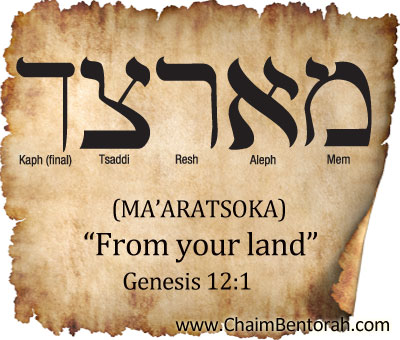
HEBREW WORD STUDY – FROM YOUR LAND MA’ARATSOKA מארצכ
Genesis 12:1: “Now the LORD had said unto Abram, Get thee out of thy country, and from thy kindred, and from thy father’s house, unto a land that I will shew thee:”
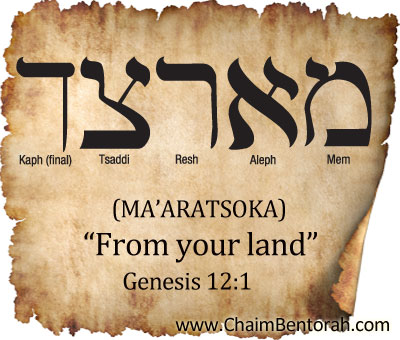 I was reading a commentary from Jewish literature and found something interesting in Genesis 12:1. The Jewish commentator said that the word country is eretz in Hebrew and is etymologically (word origins) from the word ratzon. In other words, if you trace the word back to its Semitic origins you will find that it is rooted in the ancient Canaanite word ratzon which has the idea of firmness or the will. This Jewish commentator read this with the understanding that there is a double meaning and this verse is telling us more than God telling Abraham to get out of his land. He is also telling Abraham to get out of his will, his personal and fleshly desires. The Apostle Paul even talks about the ratzon will always be present with him in Romans 7:18 “ For I know that in me (that is, in my flesh,) dwelleth no good thing: for to will is present with me; but how to perform that which is good I find not.” Even David has to literally grab hold of his will, pick it up by the collar and slam it against the wall and command it, “Soul, get with the program and start blessing the Lord:” Psalms 103:1.
If we dare to drill down to the very heart, soul, and core of that Hebrew word eretz as the Jewish masters, the masters of the Hebrew language would do we will discover a very present and personal message from God to us, “Get out of your own personal fleshly desires.”
Oh but this verse goes on, not only was Abraham commanded to leave his personal fleshly desires behind, but he was also commanded to leave his birthplace or kindred. I mean if he was commanded to leave his country he was also being commanded to leave his kindred. That sounds a little redundant to me. This redundancy was a hint to the Jewish masters that this word mowledeth (kindred) had a deeper meaning, that the ancient Semitic people heard something in this word mowledeth that we do not hear. Mowledeth comes from a Semitic the root word YLD which is found in almost every language in some form. Even in English, we have the word lad meaning a young boy which is a direct descendent from YLD which has the idea of one’s place of birth or one’s natural beginning. But as the Jewish masters explain, it goes deeper than that. YLD is a reference to one’s birthplace or natural beginning expresses the idea of being a product of a person’s environment and influences.
So God was not only commanding Abraham to leave his natural desires but to leave the environment of his birth that had pagan influences upon him. That Talmud teaches that Abraham’s father manufactured idols that were worshipped in the land of Ur. Moses was commanded to leave those godless and pagan influences.
Finally, Abraham was commanded to leave his father’s house. The Jewish masters point out that this is an idiomatic expression for the intellect. Just as your father is the authority over your behavior, your intellect becomes the authority over your behavior, hence the idiom father’s house for intellect. So Abraham was commanded to leave behind his own reasoning and intellect. Solomon put it very well in Proverbs 3:5-6 “Trust in the LORD with all thine heart, and lean not unto thine own understanding. In all thy ways acknowledge him, and he shall direct thy paths.” Our intellect is based upon what we see and hear in the natural realm, yet to really follow God we must at times lean not to our own intellect, but trust God with our hearts.
Thus, the Jewish masters see Genesis 12:1 as very relevant to us and I might add very relevant to a Christian, one who has accepted Jesus Christ as his own personal savior. Becoming a new creation in Christ means we are to leave our land or our personal will as well as our YLD or birthplace, those worldly, godless influences on our lives and to leave our father’s house, our intellect, and trust in God with all our hearts, not our intellect.
STAY IN THE LOOP
Subscribe to our free newsletter.
Leave A Comment
Hebrew Word Study – A Passion – B’ir – Beth Ayin Yod Resh Song of Solomon 3:3, “The watchmen that go about the city found me: Saw ye him who my soul loveth?” “Ich bin ein Berliner” John F. Kennedy, June 26. 1963. Translation, “I am a jelly filled donut.” There is an urban legend

HEBREW WORD STUDY – (HEARING GOD’S) VOICE – QAVAL קול Exodus 19:5: Now therefore if you will obey my voice indeed and keep my commandments, Then you will be a peculiar treasure unto me above all the people, for all the earth is mine.” What caught my attention in this verse is the thought that
-
Hebrew Word Study – A Sensitive Nature – Pathah – Pei Taw Hei פתה Psalms 116:6: “The Lord preserves the simple, I was brought low and He helped me.” Hebrew Word Study – A Sensitive Nature – Pathah – Pei Taw Hei Psalms 116:6: “The Lord preserves the simple, I was brought low and He
WORD STUDY – ABBA אבא Mark 14:35-36: “And he went forward a little, and fell on the ground, and prayed that, if it were possible, the hour might pass from him. And he said, Abba, Father, all things are possible unto thee; take away this cup from me: nevertheless not what I will, but what