
by admin
Share
by admin
Share
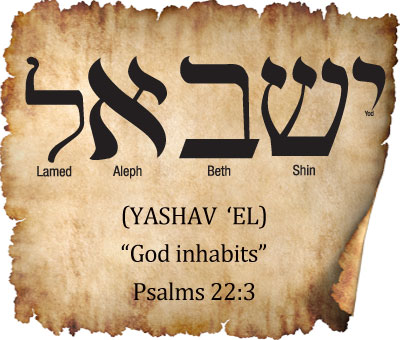
HEBREW WORD STUDY – GOD INHABITS YASHAV ‘EL ישׁב. אל
Psalms 22:3 “But thou art holy, O thou that inhabits the praises of Israel.” KJV
Psalms 22:3 “You are enthroned as the Holy one, you are the praise of Israel.” NIV
Psalms 22:3: “But thou dwellest in the Holy place, the praise of Israel.” Douay
Psalms 22:3: “And thou art holy, Sitting – the praise of Israel.” Youngs
 Does God really inhabit the praise of His people? I so love that expression and it is a favorite among worship leaders. However, I am forced to admit you do have to do a lot of stretching to get this rendering. As you can see from the various modern English versions I quote from not all agree that God inhabits the praise of His people. For one thing, it is not even talking about His people but about Israel. Of course we all the time relate His church to Israel so I no problem with saying His people. The problem lies in the syntax and Young’s Literal points out this problem with the literal reading as: “And thou art holy, Sitting – the praise of Israel.” Is God inhabiting holiness or praises? The good news, however, is that there is an ever greater treasure locked up in this verse.
The word inhabit is yashav which means many things related to dwelling. It could be sitting, remaining, staying, set in one place, an abode or establishing. My question is our bodies not the temple of God or the yashav of God?
God inhabits the praises of his people suggest that when we praise God it will somehow entice Him to join our little circle. At least that is what I sense when I hear the worship leader admonish the congregation and say: “Come on folks, let praise God because He inhabits the praise of His people.” What I am hearing that God is not yet in the midst of our congregation and we need to keep chanting to conjure Him up. It is almost like our praises are like fuel and as soon as God reaches a certain level of praise fuel He is off and running with the miracles.
As you can see from various translations, there is quite a dispute over the proper syntax of this verse. Does God inhabit the praise of His people, does he inhabit His holiness or maybe it can be read as He the praise of His people. That one cuts deep. What is the praise of your church? The pastor, the building, the numbers who attend? Of course, no one would dare not actually that God is the praise of their church but from the way I see people worship their pastors, their denomination or even their church programs or even their building, I really wonder what the praise of the church really is. How about you as an individual, what is your praise? Is it your job and performance, your house, your car? Praise expresses what your priority is.
Note carefully how this verse starts: The Lord is holy. You are familiar with that word kadesh for holy. It means to be separate, and sacred. Did you know it is also the word used for a sacred prostitute? That is one who is devoted to prostitution in honor of idols. Rahab was such a prostitute. She was dedicated to the idol so that men who had a sexual relationship with her hoping to win favor with that goddess. Hence if we see this passage as Messianic, a reference to Jesus, we have a picture of Jesus as kadesh. The one we are intimate with and in that intimacy we are drawn to the Father. And when Jesus dwells within us He becomes our praise. The word for praise here is halal which means to shine. When we say Hallelujah we are saying: “God shine in us. Let the world see you and not us.”
So if you insist on the KJV and its syntax that God inhabits the praise of His people well there is a note of redundancy as God already inhabits His people so obviously He inhabits their praise. I like the rendering that God is our praise. If the very God the universe dwells within you no treasure on earth can match that and you will be in constant praise you will not have time to praise anything else.
STAY IN THE LOOP
Subscribe to our free newsletter.
Leave A Comment
Hebrew Word Study – A Passion – B’ir – Beth Ayin Yod Resh Song of Solomon 3:3, “The watchmen that go about the city found me: Saw ye him who my soul loveth?” “Ich bin ein Berliner” John F. Kennedy, June 26. 1963. Translation, “I am a jelly filled donut.” There is an urban legend

HEBREW WORD STUDY – (HEARING GOD’S) VOICE – QAVAL קול Exodus 19:5: Now therefore if you will obey my voice indeed and keep my commandments, Then you will be a peculiar treasure unto me above all the people, for all the earth is mine.” What caught my attention in this verse is the thought that
-
Hebrew Word Study – A Sensitive Nature – Pathah – Pei Taw Hei פתה Psalms 116:6: “The Lord preserves the simple, I was brought low and He helped me.” Hebrew Word Study – A Sensitive Nature – Pathah – Pei Taw Hei Psalms 116:6: “The Lord preserves the simple, I was brought low and He
WORD STUDY – ABBA אבא Mark 14:35-36: “And he went forward a little, and fell on the ground, and prayed that, if it were possible, the hour might pass from him. And he said, Abba, Father, all things are possible unto thee; take away this cup from me: nevertheless not what I will, but what