
by admin
Share
by admin
Share
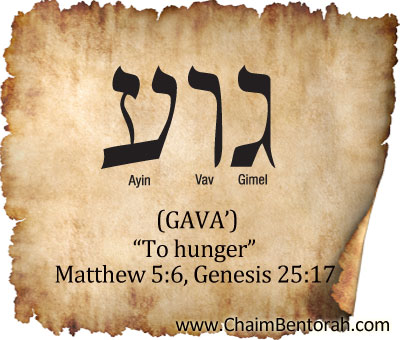
HEBREW WORD STUDY – TO HUNGER – GAVA’ גוע
Matthew 5:6: “Blessed [are] they which do hunger and thirst after righteousness: for they shall be filled.”
Genesis 25:17: “And these [are] the years of the life of Ishmael, an hundred and thirty and seven years: and he gave up the ghost and died, and was gathered unto his people.”
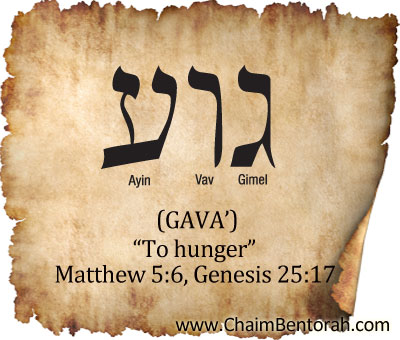 Did you know that Ishmael died a righteous man? How do we know this? I was reading something very interesting in a commentary by Rabbi Solomon Ben Isaac or Rashi which is an acronym for the first letters of his Hebrew name. He is an acclaimed Medieval French rabbi. He pointed out an ancient understanding that whenever Scripture indicates that someone has died if Scripture uses the word gava’ it means he died a righteous person. If it uses the word lamoth it means that the person did not die a righteous person.
Gava’ and lamoth both mean to die. Christian translators simply pass these words off as synonyms. Like in English we have a number of words for dying, like passing away, or to pass, to be deceased, to perish, to lose one’s life as well as a whole host of idiomatic expressions like to croak, give up the ghost, to buy it, to bit the bullet etc. So, the assumption goes, why should the Hebrew not have many words for dying. Hebrew does but each word expresses something a little different.
So the word gava’ is used for a righteous person who passes away. Hence all your lexicons will say gava’ means to die, to pass away, perish and all the other English words we might use. It totally ignores something that rabbis and people of the first century understood and that is that gava’ does mean to die and to die as a righteous person, but this word gava’ also means something else as well that we Christians somehow just never pick up on. Jesus, however, in the Sermon on the Mount talks about this, something that every Jew clearly understood and that is to kaphna after righteousness. Kaphna is the Aramaic word for hunger. The Semitic origin of the word gava’ is to hunger or be empty, to have a longing to be filled with something.
Note that Genesis 25:17 says: “Ishmael gave up the ghost and died.” Is that not the same thing to give up the ghost and die? In English, it is but in Hebrew, no it is not. Rashi was French and translated this in French but the English equivalent would be: “Ishmael gave up the ghost hungering for righteousness.” Living a righteous life was the Jews highest priority next to loving the Lord with all your heart, soul and might. If you love God with all your heart you will gava’.
So people of the first century read such passages using gava’ and probably wondered: “A person spends his life hungering for righteousness and yet dies never being filled, what a tragedy.” But Jesus assures them that one day the righteous person will be filled for Jesus Himself will take on all the sins and die for them so that there will be no barrier to being satisfied in righteousness.
I hear from a lot of Christians and many bemoan the fact that no matter how hard they try, they still fail to live a righteous life. Paul had that problem Romans 7:15: “For that which I do I allow not: for what I would, that do I not; but what I hate, that do I.” The people of the first century had the same problem, they longed to live a righteous life, they hungered for a righteous life, but were never fulfilled, they were gava’ hungering and thirsting after righteousness. Jesus made a promise to us all who gava’ who long to live a righteous life, one day we shall thanks to His finished work on the cross and His resurrection.
STAY IN THE LOOP
Subscribe to our free newsletter.
Leave A Comment
Hebrew Word Study – A Passion – B’ir – Beth Ayin Yod Resh Song of Solomon 3:3, “The watchmen that go about the city found me: Saw ye him who my soul loveth?” “Ich bin ein Berliner” John F. Kennedy, June 26. 1963. Translation, “I am a jelly filled donut.” There is an urban legend

HEBREW WORD STUDY – (HEARING GOD’S) VOICE – QAVAL קול Exodus 19:5: Now therefore if you will obey my voice indeed and keep my commandments, Then you will be a peculiar treasure unto me above all the people, for all the earth is mine.” What caught my attention in this verse is the thought that
-
Hebrew Word Study – A Sensitive Nature – Pathah – Pei Taw Hei פתה Psalms 116:6: “The Lord preserves the simple, I was brought low and He helped me.” Hebrew Word Study – A Sensitive Nature – Pathah – Pei Taw Hei Psalms 116:6: “The Lord preserves the simple, I was brought low and He
WORD STUDY – ABBA אבא Mark 14:35-36: “And he went forward a little, and fell on the ground, and prayed that, if it were possible, the hour might pass from him. And he said, Abba, Father, all things are possible unto thee; take away this cup from me: nevertheless not what I will, but what