
by admin
Share
by admin
Share
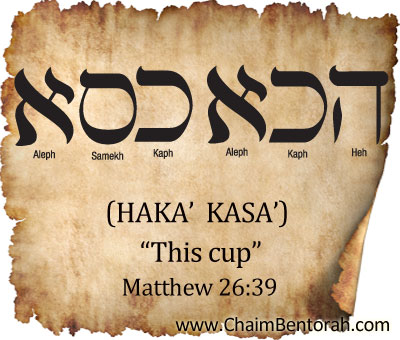
WORD STUDY: THIS CUP – הכא כס Hei Kap Aleph Kap Samek Aleph
Matthew 26:39: “And he went a little further, and fell on his face, and prayed, saying, O my Father, if it be possible, let this cup pass from me: nevertheless not as I will, but as thou wilt.”
I recently read where our American soldiers, particularly the Marines and special forces who are called upon for special missions often make an agreement before going on a mission that if they get surrounded and into a hopeless situation, they agree to fight until they are eventually killed. History is filled with brave men and women who give up their lives to protect the ones they love without a murmur or complaint. History is filled with Christians who went to their deaths for the sake of Jesus without a plea on their lips to be spared, some even went facing great torture with joy and praise to the God they love.
Then we have this story of Jesus apparently asking the Father to remove this cup from Him and then finally resigning Himself to His fate. Somehow I just have a problem with Jesus being so fearful that He is calling on His heavenly Father to pull Him out and spare him from this torture and death. It is all because we interpret the cup to mean His coming torture and death. But is that what this cup represented? Just what is the cup? I had been taught, even as a child, that this was the greatest lesson in obedience. Here Jesus is facing torture and death and is struggling against the will of his Father, not wanting to give up his life, but in the end, he submits and voluntarily gives up to the torture and death that awaits him saying: “Not my will but thine be done.” Maybe you are ok with that, I am not, I want the cup to mean something different. So I will let you decide if my interpretation here is just a bias opinion or not.
If God is perfect in love and loves us with this perfect love, why did He hesitate to go to the cross as this passage suggests? Did He really have this time of indecision, worried about His own gizzard? Many parents have watched their child desperately ill and dying and have prayed to God that he or she could trade places with that child, let the child live and they would die. They actually beg God for this. Then there is Jesus who is supposed to love us with perfect love to save us who are dying in our sins and he hesitates. No, no, no, that is not my Jesus. I’ve spent 40 years of my life studying Greek, Hebrew, and Aramaic so I could come to some peace over passages such as this one. So you will have to forgive me if I happen to read my own bias into this passage.
Jesus spoke an Old Galilean form of Aramaic (not Greek). When we read from the Aramaic version of the Bible, the Peshitta I come up with a little different rendering. First and foremost is the use of the word that is used for cup in Aramaic which is the word kasa. It is identical to the Hebrew word kavas which is also the word found in other Semitic languages that are used for a stork. The stork was noted for its tender loving care of its young. Even care for young not its own. Legend has it that during the time of famine a mother stork will peck her breast till it bleeds and feed her young with her own blood. Legend also teaches that if one of the stork’s chicks died, the mother stork would resurrect its young with its own blood. This is the same word Jesus used at the last supper when He said that this cup (not this wine) is my blood. In other words, this nurturing love is my blood. The Semitic mindset of the disciples would have allowed them to see a little play on words in this context. It would be his blood that would resurrect us and restore us to a rightful position with God, but it would be bloodshed out of deep love and nurturing.
In the garden, Jesus is praying that this kasa (cup, nurturing love) would pass from Him. In Greek, the word pass is parelthato which means to avert, avoid, or pass over. But if this word for pass was spoken in Aramaic and later translated into Greek, it is possible the Aramaic might be closer to what Jesus said which was the word avar that is used in the Peshitta. Now avar in Aramaic is the same word in Hebrew and has a wide range of meanings. The word itself is the picture of a river overflowing onto its banks. You could say that it is passing over, but it more correctly it would be overwhelming. Yes, the human part of Jesus was not looking forward to the coming torture and pain but Jesus was not praying to get out of this situation but it was this cup or this nurturing, sacrificial love for us that so overwhelmed him that He could not bear it, just as a parent watching their child suffering and dying in a hospital bed cannot bear to watch the love of their life in such torment.
Note in verse 37 it says he became sorrowful. That word sorrowful in the Aramaic is kamar which means to burn or kindle and is used for a burning love or compassion. As Jesus was about to make the sacrifice of His own life His entire being was filled with burning love and compassion for mankind. He would be filled over such sorrow knowing that even though He was making this supreme sacrifice there would still be millions upon millions who would not only reject His sacrifice but scorn it and mock it as well.
STAY IN THE LOOP
Subscribe to our free newsletter.
Leave A Comment
Hebrew Word Study – A Passion – B’ir – Beth Ayin Yod Resh Song of Solomon 3:3, “The watchmen that go about the city found me: Saw ye him who my soul loveth?” “Ich bin ein Berliner” John F. Kennedy, June 26. 1963. Translation, “I am a jelly filled donut.” There is an urban legend

HEBREW WORD STUDY – (HEARING GOD’S) VOICE – QAVAL קול Exodus 19:5: Now therefore if you will obey my voice indeed and keep my commandments, Then you will be a peculiar treasure unto me above all the people, for all the earth is mine.” What caught my attention in this verse is the thought that
-
Hebrew Word Study – A Sensitive Nature – Pathah – Pei Taw Hei פתה Psalms 116:6: “The Lord preserves the simple, I was brought low and He helped me.” Hebrew Word Study – A Sensitive Nature – Pathah – Pei Taw Hei Psalms 116:6: “The Lord preserves the simple, I was brought low and He
WORD STUDY – ABBA אבא Mark 14:35-36: “And he went forward a little, and fell on the ground, and prayed that, if it were possible, the hour might pass from him. And he said, Abba, Father, all things are possible unto thee; take away this cup from me: nevertheless not what I will, but what