
by admin
Share
by admin
Share
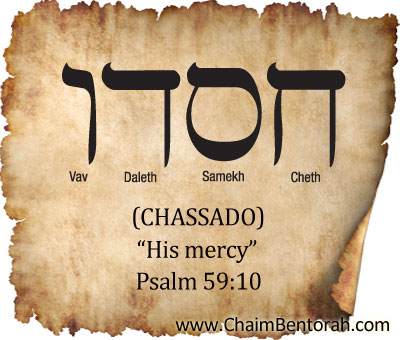
HEBREW WORD STUDY – HIS MERCY – CHASSADO – חסדו Cheth Samek Daleth Vav
Psalms 59:10: “The God of my mercy shall prevent me: God shall let me see [my desire] upon mine enemies.”
Let me show you something that you will not find in any English translations. The only way you will see this is by looking at the Hebrew text. There are many things missing in our English translations because they just cannot be expressed in English and you need to read it in the Hebrew to actually see. This is why I offer a 12 week Hebrew class on our All Access Site. We just do not end after 12 weeks but we continue to offer a live Hebrew class for as long as you subscribe to our all Access Site. This class is a continuous class where each Monday evening we take a passage of Scripture and translate it going over and over all the things you learned in the 12-week class and then some more. This is an example of the “then some more.” In five years of studying Hebrew in Bible Colleges and Seminaries under various teachers, I never had a teacher explain this rather common occurrence in the Hebrew texts. Not that they do not know about this, it just never came up in my classes. I had to have a rabbi explain it to me.
If you look up this verse in Bible Hub on your computer and click on the menu where you see Hebrew, you will see the Hebrew text with the English translations. You will notice the second-word chassad is repeated twice. The interlinear appears to translate the word the first time as of. I assure you they are not translating it as of. But they have a reason to put the of there. When the word is repeated it is in brackets. This indicates that it is to be written one way but read as another way. In other words it is to be written as His mercy but read as my mercy. You see in the Hebrew text the word chassad is written as chassado (His kindness or mercy) and the second time as chassadi (my kindness or mercy). The reason for this is that the writer is trying to express the perspective of the doer – chassado His kindness – as well as the perspective of the recipient – chassadi – my kindness.
How do you represent these two perspectives in just one translation? Many translators will simply render this as the “God of my mercy.” By using the preposition of you can almost convey the idea of both perspectives. But did you catch that in your first reading from the King James Version? I didn’t, not even in multiple readings did I get the idea of the two perspectives, the mercy coming from to the writer. Not until I saw it in the Hebrew did I really get the idea that two perspectives were being emphasized.
But isn’t it pure logic that mercy comes from someone to someone else. Is that not the very essence of mercy, it is something given? Why did the writer or more specifically God who inspired this want to emphasize His mercy, my mercy. Ponder the literal translation for a moment. The God of His mercy, my mercy shall prevent me.
The word for prevent is qadam in a Piel imperfect form. Qadam means to come, before or to meet. The Jewish commentator Metzudot expresses the Piel imperfect as: “The God Who has always done kindness to me. In other words, God’s mercy is always before me, I am always encountering His mercy. I cannot escape His mercy. When the enemy comes after me full steam ahead like a flood he plows right into the mercy of God which is before me Isaiah 59:19. That mercy of God is a brick wall protecting us from the onslaught of the enemy.
There are occasions when God allows the enemy through that wall, but only with His permission as in the case of Job. The only way to strengthen our faith is for our faith to be tested. So He will allow the enemy to try our faith, but keep in mind the enemy knows full well that it is chassdo – God’s mercy not our mercy that is cutting him down to size.
STAY IN THE LOOP
Subscribe to our free newsletter.
Leave A Comment
Hebrew Word Study – A Passion – B’ir – Beth Ayin Yod Resh Song of Solomon 3:3, “The watchmen that go about the city found me: Saw ye him who my soul loveth?” “Ich bin ein Berliner” John F. Kennedy, June 26. 1963. Translation, “I am a jelly filled donut.” There is an urban legend

HEBREW WORD STUDY – (HEARING GOD’S) VOICE – QAVAL קול Exodus 19:5: Now therefore if you will obey my voice indeed and keep my commandments, Then you will be a peculiar treasure unto me above all the people, for all the earth is mine.” What caught my attention in this verse is the thought that
-
Hebrew Word Study – A Sensitive Nature – Pathah – Pei Taw Hei פתה Psalms 116:6: “The Lord preserves the simple, I was brought low and He helped me.” Hebrew Word Study – A Sensitive Nature – Pathah – Pei Taw Hei Psalms 116:6: “The Lord preserves the simple, I was brought low and He
WORD STUDY – ABBA אבא Mark 14:35-36: “And he went forward a little, and fell on the ground, and prayed that, if it were possible, the hour might pass from him. And he said, Abba, Father, all things are possible unto thee; take away this cup from me: nevertheless not what I will, but what