
by admin
Share
by admin
Share
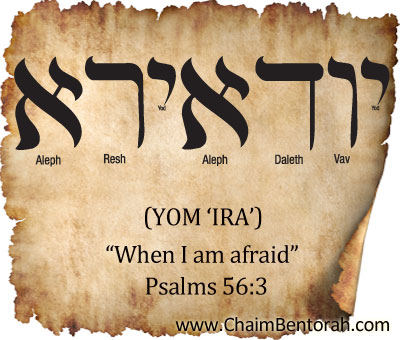
HEBREW WORD STUDY – WHEN I AM AFRAID – YOM ‘IRA’ יום אירא Yod Vav Daleth Aleph Yod Resh Aleph
[sg_popup id=”14144″ event=”onLoad”][/sg_popup]Psalms 56:3 “What time I am afraid, I will trust in thee. In God I will praise His Word, in God I will put my trust; I will not fear what flesh can do unto me.”
This Psalm gives a rather strange combination of words. “What time I am afraid” does sound awkward, but it is very close to the original Hebrew. The expression is “yom ‘ira’.” It could be rendered literally as “a day that I am fearing.” All of us have some day off in the future that we dread. It may be a coming exam, a yearly review at your job, tax time, your yearly physical or maybe even the holiday season. Since it is a future event, we tend to put it out of our minds until some little occurrence jogs our memory and instantly that sense of dread comes back. Or we may be like Charlie Brown who walks around with a storm cloud over his head and his head alone.
The grammatical structure of verse 3 is a little odd for the context. David is reflecting on his capture by the Philistines at Gath and then he says: “The day that I am fearing…” The word fear ‘ira’ is in a participial form, an event that is going to take place. Yet, the event is over with, so what does he fear?
I read a biography of Abraham Lincoln while he was president. His wife got into some kind of scandal but the Secretary of State Steward managed to control it. When he told Lincoln, the president showed no joy but only became very melancholy and went to his desk, sat down and hung his head. Secretary Seward spoke up: “Mr. President, perhaps you misunderstood, the problem with your wife is resolved.” President Lincoln quietly replied: “I know it’s resolved, I’m just worried about the next problem she will cause.” “What problem is that,” inquired Seward.” President Lincoln replied: “Oh, I don’t know but there will be one.”
This is most likely the case with David. The problem with the Philistines had long been resolved, but David knew that his future held many similar problems. Reflecting on his experience with the Philistines probably jogged his memory that he had another stressful situation facing him in the future but his response was: “I will trust in thee.” I fully expected to find the word batach for trust to also be a participial. It is not, it is in a simple qal future form. David is confronting a future problem and he saying: “I will trust in the Lord.” This is not David’s style of writing. To be typical of David’s style he would have made this a participle: “I am trusting in the Lord.”
As I meditate on this, I realize that this is typical David. In Matthew 6:34 Jesus instructed us to not worry about tomorrow for tomorrow will take care of itself. Each day has enough trouble of its own. David was simply following this advice. There was no sense in trusting God for something that hasn’t yet appeared on the horizon. David could have said: “God I am trusting you for the day the Assyrians show up at my door. I am trusting you to take care of me; I am trusting you for favor.” Yet, he would just be worrying and fretting about the event rather than simply saying: “Hey, if that happens, I will simply trust God at that time the way I did when I was taken captive with the Philistines.” David refused to walk around with that storm cloud over his head. I don’t know about you but I tend to find myself in the President Lincoln mode rather than the David mode saying: “Well that problem is resolved, not what am I going to do when the next problem shows up?” The fact is I am going to do with the next problem what I did with the last problem. I am going to trust God and I am going to watch Him deliver me as he did with the last problem.
In Psalm 56:3 David is declaring that he was not going to live from problem to problem, rather he was going to put all future problems in the hands of the God that he loved and just live from glory to glory. That word “trust” batach is a word I have mentioned in past studies. It means to cling to, adhere to or be welded to. David is also saying that he was melted into God. His problems were God’s problem.
Calvin Coolidge once said when asked by a reporter why he appeared so calm when he was burdened with the office of the President. He replied: “If I see ten problems walking down the road, I know that nine will fall into a ditch before they ever reach me.
So the next time you find yourself worrying over some future problem that hasn’t even come down the road yet, just do what David did. Pray and say: “Well, Lord, I am welded (batach) to you. So when our problem comes knocking at our door, I will let You answer the door.
STAY IN THE LOOP
Subscribe to our free newsletter.
Leave A Comment
Hebrew Word Study – A Passion – B’ir – Beth Ayin Yod Resh Song of Solomon 3:3, “The watchmen that go about the city found me: Saw ye him who my soul loveth?” “Ich bin ein Berliner” John F. Kennedy, June 26. 1963. Translation, “I am a jelly filled donut.” There is an urban legend

HEBREW WORD STUDY – (HEARING GOD’S) VOICE – QAVAL קול Exodus 19:5: Now therefore if you will obey my voice indeed and keep my commandments, Then you will be a peculiar treasure unto me above all the people, for all the earth is mine.” What caught my attention in this verse is the thought that
-
Hebrew Word Study – A Sensitive Nature – Pathah – Pei Taw Hei פתה Psalms 116:6: “The Lord preserves the simple, I was brought low and He helped me.” Hebrew Word Study – A Sensitive Nature – Pathah – Pei Taw Hei Psalms 116:6: “The Lord preserves the simple, I was brought low and He
WORD STUDY – ABBA אבא Mark 14:35-36: “And he went forward a little, and fell on the ground, and prayed that, if it were possible, the hour might pass from him. And he said, Abba, Father, all things are possible unto thee; take away this cup from me: nevertheless not what I will, but what