by admin
Share
by admin
Share
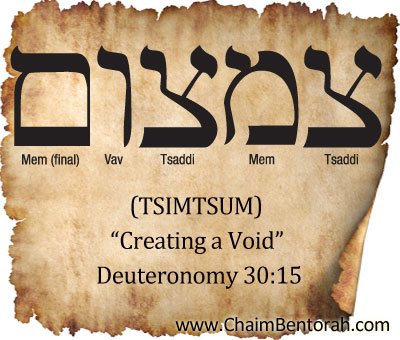
HEBREW WORD STUDY – CREATING A VOID -TSIMTSUM – צמצום Sade Mem Sade Vav Mem
Deuteronomy 30:15: “See, I have set before thee this day life and good, and death and evil;”
Did you ever have a Jewish friend give you a hard time about the Trinity, you know, how can you say you believe in one God when you have three, Father, Son and Holy Spirit. I mean like forget it, no matter how you try to explain it, it still sounds contradictory. There is no way to explain it, the church teaches that it is a mystery. If I am faced with such a question by a Jewish friend I simply answer with a question. Explain tsimtsum to me. He will most likely say it is a paradox and I will reply so is my belief in the Trinity. If I say three gods equal one god then that is a contradiction. But what I am saying is three persons equal one God which is a paradox. Now how is tsimtsum a paradox? A paradox could be like my nephew and his wife who both hold a doctorate in pharmacology – you know a pair of docs – forget it. A paradox is a seeming contradiction but in reality expresses a truth.
I will not go into the Trinity. Although I do believe in the Trinity I can’t explain it but I hold it as a truth. Tsimtsum, however, is also a true paradox. As simply as possible and if there is a Kabbalist reading this I am sure he will throw salt in the air, tsimtsum is to be present in your absence. Tsimtsum simply means a reduction. It is like another great paradox in Christianity as to how could Jesus can be both God and man at the same time. Well, through tsimtsum (I think I just head the thud of a Kabbalist passing out). But hear me out does not Scripture teach Jesus made Himself a little lower than the angels (Hebrew 2:7). Does it not say He emptied Himself? Philippians 2:7-11. That is my understanding of tsimtsum. I sure can’t explain it but I accept it as a fact.
The idea behind tsimstsum, which is a Hebrew word not found in the Bible but found in extra Biblical literature, is that the ‘o(h)r ein sof (infinite light) had to be reduced, constricted tsimtsum in order for God to create the physical universe. The physical universe is sort of like a dark bubble in the center of the ‘or ein sof. Light here may be just a metaphor, but who really understands light, we just know it is energy which gives off wave patterns. But what is light really? Jesus said He is the light. That may not mean He is a glowing object but He is the essence of all that exist, all of life.
Note God says in Deuteronomy 30:15 “…this day I set before thee life and good, death and evil. Jewish teachers point to this verse to demonstrate tsimtsum. God had to step aside to create the physical world but if He were not in it, it would not be good, in harmony with Him but would be evil ra’a which is not in harmony with God. So He creates this world, creates life and then somehow He is both absent and present.
So why am I messing with something I don’t understand? Because this paradox explains something to me. I was reading one Jewish writer who said the journeys of the children through the wilderness created a tsimstum. I was watching a documentary of a man trying to ski to the South Pole. He entered a land where no life existed, it was barren other than ice and snow, sort of like a desert. Without his supplies his life would have quickly ended. This was like the desert between Egypt and the Promised Land. It was virtually lifeless except for poisonous snakes, scorpions, heat that would quickly dehydrate you and swiftly end the lives of the very young and the old. The night would bring many other dangers and yet, somehow the people survived this harsh life ending environment. How could they do that? There was a pillar of fire by night and a pillar of cloud by day. Both representatives of the o(h)r ein of of God, the infinite light of God who tsimtsum was both present and absent. As long as the people chose God He was present, when they did not chose Him, His absence would become apparent. God create tsimtsum as the only way to give man a free will, the ability to choose Him.
So we live today in the tsimtsum of God. When we accept Him as our Savior we enter his bubble of protection, caring and loving, while we live in that paradox where He could be absent if we do not choose Him.
STAY IN THE LOOP
Subscribe to our free newsletter.
Leave A Comment
Hebrew Word Study – A Passion – B’ir – Beth Ayin Yod Resh Song of Solomon 3:3, “The watchmen that go about the city found me: Saw ye him who my soul loveth?” “Ich bin ein Berliner” John F. Kennedy, June 26. 1963. Translation, “I am a jelly filled donut.” There is an urban legend
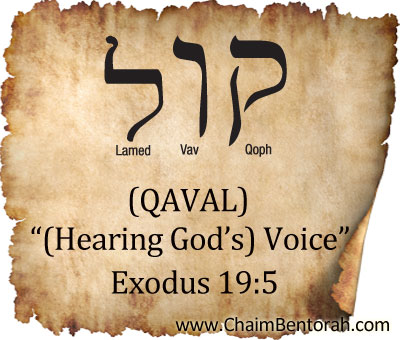
HEBREW WORD STUDY – (HEARING GOD’S) VOICE – QAVAL קול Exodus 19:5: Now therefore if you will obey my voice indeed and keep my commandments, Then you will be a peculiar treasure unto me above all the people, for all the earth is mine.” What caught my attention in this verse is the thought that
-
Hebrew Word Study – A Sensitive Nature – Pathah – Pei Taw Hei פתה Psalms 116:6: “The Lord preserves the simple, I was brought low and He helped me.” Hebrew Word Study – A Sensitive Nature – Pathah – Pei Taw Hei Psalms 116:6: “The Lord preserves the simple, I was brought low and He
WORD STUDY – ABBA אבא Mark 14:35-36: “And he went forward a little, and fell on the ground, and prayed that, if it were possible, the hour might pass from him. And he said, Abba, Father, all things are possible unto thee; take away this cup from me: nevertheless not what I will, but what