
by admin
Share
by admin
Share
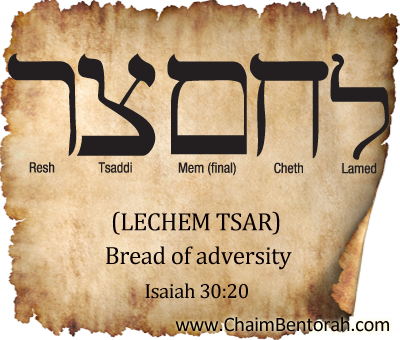
HEBREW WORD STUDY – BREAD OF ADVERSITY – LECHEM TSAR לחם צר Lamed Cheth Mem Sade Resh
Isaiah 30:20: “And though the Lord give you the bread of adversity, and the water of affliction, your teachers be hidden no more, but thine eyes shall see they teachers:”
Translators appear to have been very careful to render the words lechem tsar as bread of adversity rather than bread of affliction, which an appropriate rendering. But that would smack very closely to lechem oni, also bread of affliction, and no matter how little a modern English speaking Jew would understand Hebrew and he would quickly recognize the words bread of affliction as the first words from the Haggadah to be read on the Passover celebration. Matzo is also known as the bread of affliction because the Jews would have to exit Egypt with great hast after the last plague and they would have no time to add leaven to their bread. Matzo is the cracker-like flatbread that Jews eat on Passover. Also, while in slavery the Jews were forced to go to work for long hours and often could not bake bread with leaven and thus matzo became a symbol of their oppression as slaves.
Odd but mayim lachats is rendered as waters of affliction. This may very well be a playoff the word bread which is lechem coming from a similar Semitic dual root. Although lachats means to crush or squeeze it is another word for oppression as that is what oppression does is squeeze the life out of you. This all may be a poetic play on words that Isaiah could be used to make a statement to reflect on the Jew’s deliverance from Egypt where that deliverance involved tsar adversity and lachats where their experience crushed or squeezed their unbelief out of them.
Isaiah may have chosen the word lachats because you could also read it with the Lamed as a preposition to the word chats which in its root chatsats means a separation or in its verbal form to separate. Thus, you have the waters of separation as another hidden or esoteric reference to the time of the Passover where final deliverance from Egypt came with the separation of the waters of the Red Sea.
Would you like Chaim Bentorah as your personal Hebrew teacher?
|
|
But what does all this have to do with the context. Ok, Isaiah got the Jews attention with this coded reference to the Exodus and the Passover but what does water have to do with affliction. The word water in Hebrew is mayim, This could come from the root word mi waters or yim hot springs. I don’t believe this is where our English idiom being in hot water comes from, but it is a cool idea. Water has many symbolic meanings in Hebrew. One meaning is that water can be so powerful it can drill through rocks. Hence we would draw the idea of waters of affliction. I have read in Jewish literature that God will give you an affliction that will drill through the rocky covering of your heart to penetrate your heart with the love of God. Just as God gave Israel their afflictions to reach their heart. God does not allow us to go through affliction randomly, He is seeking to penetrate your heart so your heart will be open to Him.
We not only experience waters of affliction to drill through our rocky hearts, but we also may face the bread of adversity. Bread also has many symbolic meanings. One aspect is how bread is made. The taking of wheat, pounding it into a flower, rolling it and then baking it at a high temperature. The Jewish community recently celebrated Rosh Hashanah. It is a custom in baking bread for Rosh Hashanah to invite people who have hurt you during the year to assist you in the preparation. As you roll your bread you forgive them. Hence the bread of adversity. Jewish literature teaches that the adversity brought on by your sinful acts is pounded, rolled, and baked to bring you to repentance and the forgiveness of God. I would also like to add my thought to this. That grain which is pounded, rolled, and baked comes out as something new (bread) to bring nourishment to others. Many people have to go through the waters of affliction for God to penetrate their hearts and then go through the pounding, rolling and baking trials by God to bring them to repentance and His forgiveness in Jesus Christ so that Jesus can make them into something new, something of value to others, to bring nourishment to others.
Your teachers shall be hidden no more. Teachers in this passage is moreka. This particular form is a participial noun, 2ndperson singular. Note it is singular not plural. It is a teaching teacher or a master teacher. The word used here is yarah not lamad which is the common word for teach. Yarah has the idea of throwing out, or an archer who is shooting an arrow. A teacher is throwing out knowledge or shooting out knowledge that is aimed at a target. This Master Teacher will not be hidden. The word hidden is kanaph. This is the word for wings or a loose flowing skirt. These particular words give a picture of an archer shooting at a winged creature but because of its illusiveness, the arrow shot by our Master Teacher does not meet its target. God is constantly speaking to us, but we just keep eluding His voice.
The last part of this verse also explains it. And your eyes will see your teachers. The word see is ra’ah which is a reference to spiritual seeing, spiritual insight. Your spiritual eyes will be opened and you will see the redemption offered by our Master Teacher.
What the prophet seems to be saying here is that God is always speaking to us, to give us direction, to set us on the right path or way (see following verse) but sometimes it just does not get through that thick skull of ours or that thick rocky heart of ours and God may have to bring the bread of adversity, (adversity that will bring us into repentance and the forgiveness of God) or the waters of affliction to break through that shell of our heart and pierce it with the love of God through Jesus Christ.
Hi there! Thank you for reading this Daily Word Study. Can I ask a favor? Share this Daily Word Study with your friends on Facebook and Twitter by clicking one of the icons below.
Thanks & Blessings, it means a lot to me!
STAY IN THE LOOP
Subscribe to our free newsletter.
Leave A Comment
Hebrew Word Study – A Passion – B’ir – Beth Ayin Yod Resh Song of Solomon 3:3, “The watchmen that go about the city found me: Saw ye him who my soul loveth?” “Ich bin ein Berliner” John F. Kennedy, June 26. 1963. Translation, “I am a jelly filled donut.” There is an urban legend

HEBREW WORD STUDY – (HEARING GOD’S) VOICE – QAVAL קול Exodus 19:5: Now therefore if you will obey my voice indeed and keep my commandments, Then you will be a peculiar treasure unto me above all the people, for all the earth is mine.” What caught my attention in this verse is the thought that
-
Hebrew Word Study – A Sensitive Nature – Pathah – Pei Taw Hei פתה Psalms 116:6: “The Lord preserves the simple, I was brought low and He helped me.” Hebrew Word Study – A Sensitive Nature – Pathah – Pei Taw Hei Psalms 116:6: “The Lord preserves the simple, I was brought low and He
WORD STUDY – ABBA אבא Mark 14:35-36: “And he went forward a little, and fell on the ground, and prayed that, if it were possible, the hour might pass from him. And he said, Abba, Father, all things are possible unto thee; take away this cup from me: nevertheless not what I will, but what