
by admin
Share
by admin
Share
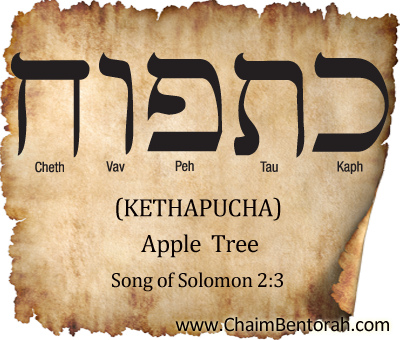
HEBREW WORD STUDY – APPLE TREE – KETHAPUCHA כתפוח Kap Taw Pei Vav Cheth
Song of Solomon 2:3: “As the apple tree among the trees of the wood, so [is] my beloved among the sons. I sat down under his shadow with great delight, and his fruit [was] sweet to my taste.”
This verse is taken from a story which is an allegory of God’s relationship with us as the believer. It is a love story of a King, believed to be Solomon, who is in love with a peasant woman identified as just the Shulamite woman. This is a forbidden love as the Jewish Midrash teaches she was betrothed to a shepherd but as in any story of romance, love conquers all.
In Chapter 2 of the story of the Song of Solomon King Solomon and the Shulamite woman are sharing their thoughts with us, the readers, about the nature of their love for each other. In verse 3 the Shulamite woman is speaking and she declares that her beloved, King Solomon, is like an apple tree among the trees in the woods or forest. This verse points out that the tree is her beloved and the woods are the sons. In Semitic literature, one is referred to as a son even if there is no blood relationship. Even today in the Middle East one of the greatest compliments one gives you is if they say: “You are my brother.” If there is a wide age difference they will say: “You are my son.” This is not to say you are a blood relative but that they feel as devoted to you as if you were a blood relative. We do the same in our culture saying someone is like a brother or son to us only in the Middle East they don’t say like or as but simply say “you are.”
So, among all the trusted men in the royal court, her beloved is like an apple tree. The word apple tree in Hebrew here is kethapucha from the root word napach. This is a loan word from the Persian language which means an apple or apricot. In Hebrew, it carries that idea as well as being a word for an apple tree. It is also a word for exhaling and blowing. It is also used to express the idea of speaking directly to someone, not through a proxy. In a way, she is saying that it is his breath, his words that she only wishes to hear, not the opinions of his friends or servant. Another idea is that she can go directly to her beloved without having to go through a lot of red tapes and trying to get past guards and gatekeepers. The very breath of the King welcomes her into his court. The King is the apple tree, the one she wants to communicate with. All the king’s’ horses and all the king’s men could not keep her from her beloved. When she enters the court of King Solomon she can approach him directly. Another thought that has been put forward is that an apple tree offers very little shade compared to the other trees of the forest. She is interested only in the fruits of his character where others just want his protection and will go to anyone who can provide better protection. Their loyalties lie in what it means to them, her loyalty lies in her love for the King.
Would you like Chaim Bentorah as your personal Hebrew teacher?
|
|
But the Midrash points out something that I really like and I believe that is the interpretation I would go with. The buds to the fruit of an apple tree sprout before the leaves come. Usually, it is the leaves that come first to provide nourishment to the tree to produce the fruit. The Midrash points out that the leaves represent hearing the Word of God and the fruits are our good works. Good works usually come after studying the Word of God but good works do not have to wait until you have a full understanding of the Word of God. That is an interesting thought. We need a foundation of the Word of God before we minister, but nothing says we cannot do some type of work for God while we are growing in our knowledge of God’s Word.
Another way to look at it is that the Shulamite woman did not have to wait for the permission of the leaves or the other trees, she was able to go directly to the king, her beloved. This is just like our relationship with Jesus, we have the right to go directly to Jesus with our request and petitions because we are His bride His beloved.
The rest of the verse talks about sitting down in His shadow. The preposition “in” is not in the text it is simply I desire His shadow. But without the preposition, the object would not be a shadow but Him. She delights in Him and the Shadow or shade He creates for her is just a byproduct. It is the King she delights in and welcomes his shadow which is a symbol of protection.
The word delight in Hebrew is chamad which means to covet or desire. Her desire is the King, the shadow is a fringe benefit. So too in our relationship with Jesus. Is our delight or desire just for His protection, for what He can give us? Or is our desire just for Him and anything else is just a fringe benefit?
Jesus is our Apple Tree that we go to for shade or protection. But suppose there are protections out there that seem more secure than Jesus. Will we abandon Him for the other trees which seem to offer more in the line of protection and what we want? Or are we satisfied with what protection we get because our chamad or desire is for Him, not the shade he provides?
Hi there! Thank you for reading this Daily Word Study. Can I ask a favor? Share this Daily Word Study with your friends on Facebook and Twitter by clicking one of the icons below.
Thanks & Blessings, it means a lot to me!
STAY IN THE LOOP
Subscribe to our free newsletter.
Leave A Comment
Hebrew Word Study – A Passion – B’ir – Beth Ayin Yod Resh Song of Solomon 3:3, “The watchmen that go about the city found me: Saw ye him who my soul loveth?” “Ich bin ein Berliner” John F. Kennedy, June 26. 1963. Translation, “I am a jelly filled donut.” There is an urban legend

HEBREW WORD STUDY – (HEARING GOD’S) VOICE – QAVAL קול Exodus 19:5: Now therefore if you will obey my voice indeed and keep my commandments, Then you will be a peculiar treasure unto me above all the people, for all the earth is mine.” What caught my attention in this verse is the thought that
-
Hebrew Word Study – A Sensitive Nature – Pathah – Pei Taw Hei פתה Psalms 116:6: “The Lord preserves the simple, I was brought low and He helped me.” Hebrew Word Study – A Sensitive Nature – Pathah – Pei Taw Hei Psalms 116:6: “The Lord preserves the simple, I was brought low and He
WORD STUDY – ABBA אבא Mark 14:35-36: “And he went forward a little, and fell on the ground, and prayed that, if it were possible, the hour might pass from him. And he said, Abba, Father, all things are possible unto thee; take away this cup from me: nevertheless not what I will, but what