
by admin
Share
by admin
Share
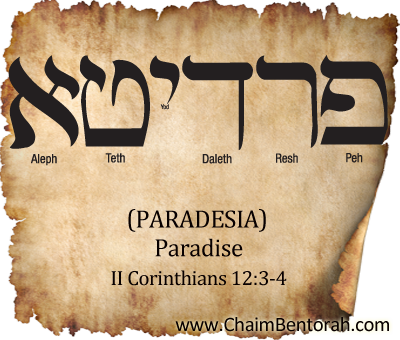
Aramaic Word Study – Paradise – Paradesia פרדיטא Pei Resh Daleth Yod Teth Aleph
II Corinthians 12:3-4: And I know such a man—whether in the body or out of the body I do not know, God knows. (4) How that he was caught up into paradise, and heard unspeakable words, which it is not lawful for a man to utter.
I remember reading a story about an American executive for Ford Motors who went to the old Soviet Union during the Stalin regime as a consultant and got caught in the political crisis of that ear. It was before World War II and through circumstances pretty common during that time this American’s son was sentenced to the Gulag. After his release he was forced to remain in Siberia as he tried to find a way back to the United States. During this time he married a Russian woman and they had a daughter that they tried to raise in Siberia in the abject poverty of that time. At nights when the little family huddled around a fire to try and stay warm and after eating a scanty meal the daughter would ask her father to tell her about American. The father tried to describe the abundance of food, the warmth in their homes and many of the other marvels of that day. The daughter who was only about six years old and never knew anything but the poverty and bitter cold of Siberia kept asking what it was like to live in America. The father tried many ways to describe it to her but she could not comprehend until one day she said: “Daddy, does it mean that if you live in American you get to eat two potatoes for dinner instead of one?” The father realizing that this was the only way her daughter could understand life in America said; “Yes, living in America means you get to eat two potatoes for dinner instead of one.” Her eyes just beamed as she consider this unusual luxury.
I think of this story often, especially now that I am entering my latter years and try to imagine what heaven is like. But I also think about it when I hear someone tell a story of their visit to heaven either in the body or out of the body. Unlike Paul who says he cannot explain what he saw, many of these people appear on television, radio, podcast and write best selling books to explain what heaven is like. Those who do try to explain what heaven is like simply picture something like it is here on earth only more beautiful.
I tend to think many these stories are simply one’s imagination or just a hoax to get their 15 minute of fame because if you could describe heaven, I think Paul would have done it. The stories that I do believe and have merit are those from people who say like Paul: “I can’t describe it. To make you understand I would have to compare it to something in the natural and there is nothing in the natural to compare it to.”
I am convinced that the best description would be no more accurate than that little girl’s understanding of America, a place where you get two potatoes for dinner and not just one. Any other description would be beyond her comprehension.
Would you like Chaim Bentorah as your personal Hebrew teacher?
|
|
The word paradise in Greek is paradeison which is really a loan word from the ancient Persian meaning “enclosure, garden or a park.” The Aramaic word is pardaisa which is the same as the Greek meaning a walled garden. The Persian root is pard which means to separate or flee. It is a root word used in modern Semitic languages for atomic particles which separate to form matter. More to the ancient language it would be a word for apeiron which in first century scientific thought was the primal principle of all matter. It was an attempt by ancient scientist who rejected the supernatural and sought to find an origin of matter. With the education that Paul had he would have been exposed to the Greek principle of apeiron and probably used the word pardaisa to explain a place where all things of the physical world originated.
This letter by Paul was written to Corinth. The people of Corinth and many of the church of Corinth that was established by Paul were classically educated. Originally a Greek city it was soon conquered by Julius Caesar 100 BC to 46 BC. When the Romans took over it was ruled by a people of fine education who created a cultural center of sorts. It would make sense that Paul would appeal to their classical education which would include the science of that day and the knowledge of apeiron to speak about heaven, only he would use the word paradeison which would be recognized by this scientific people
He heard unspeakable words. In the Aramaic this is melatha la which literally means no words. He heard no words. The word for unlawful is shalat which literally means given or to handle power or authority. The emphasis is on the word handle and would read to handle authority or power but with the word la it would literally read too much power to handle. In Aramaic it would read that he heard no words which were not too powerful to handle. Literally, what he saw and heard was beyond his ability to handle or communicate.
The Talmud teaches that you can describe the taste of meat to a man who has never tasted meat but you can never really help him understand what meat taste like until he actually tastes it. Until we actually cross over to heaven there is not book, no sermon nor testimony that will help us understand what heaven is really like. The best we can understand is that heaven is like having two potatoes instead of one. But just between you and me, you know and I know heaven is no small potatoes.
Hi there! Thank you for reading this Daily Word Study. Can I ask a favor? Share this Daily Word Study with your friends on Facebook and Twitter by clicking one of the icons below.
Thanks & Blessings, it means a lot to me!
STAY IN THE LOOP
Subscribe to our free newsletter.
Leave A Comment
Hebrew Word Study – A Passion – B’ir – Beth Ayin Yod Resh Song of Solomon 3:3, “The watchmen that go about the city found me: Saw ye him who my soul loveth?” “Ich bin ein Berliner” John F. Kennedy, June 26. 1963. Translation, “I am a jelly filled donut.” There is an urban legend

HEBREW WORD STUDY – (HEARING GOD’S) VOICE – QAVAL קול Exodus 19:5: Now therefore if you will obey my voice indeed and keep my commandments, Then you will be a peculiar treasure unto me above all the people, for all the earth is mine.” What caught my attention in this verse is the thought that
-
Hebrew Word Study – A Sensitive Nature – Pathah – Pei Taw Hei פתה Psalms 116:6: “The Lord preserves the simple, I was brought low and He helped me.” Hebrew Word Study – A Sensitive Nature – Pathah – Pei Taw Hei Psalms 116:6: “The Lord preserves the simple, I was brought low and He
WORD STUDY – ABBA אבא Mark 14:35-36: “And he went forward a little, and fell on the ground, and prayed that, if it were possible, the hour might pass from him. And he said, Abba, Father, all things are possible unto thee; take away this cup from me: nevertheless not what I will, but what