
by admin
Share
by admin
Share
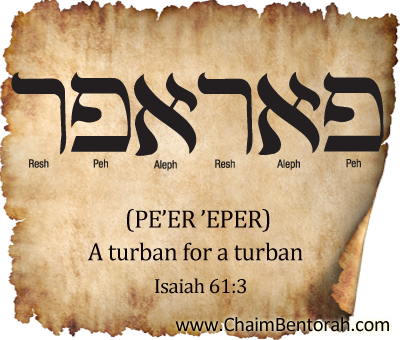
Hebrew Word Study – A Turban for a Turban – Pe’er ’Eper פאר אפר Pei Aleph Resh Aleph Pei Resh
Isaiah 61:3: “To provide for the mourners in Zion, to give them beauty instead of ashes.”
The word for beauty here is pe’er.” This is spelled Pei, Aleph, and Resh and the word for ashes is ’eper which is spelled Aleph, Pei, and Resh. Both words are almost identical and both can be used to represent a turban.
Even Muslims will admit that turbans have their origins in Judaism. Oddly, it is rarely used by Jews today. Turbans have taken on many different meanings throughout its history. Among the Jews, it was to be a sign of purity and honor. Aaron as a high priest wore a turban as well as his sons. This was to be a sign that they were pure enough to be honored as a priest.
Turbans were made of fine linen. Fine linen of ancient times was very difficult to come by and only the wealthy could afford it and by the time of Isaiah it was a sign of wealth or authority.
So why does Isaiah use pe’er and ‘eper and why do we not translate this as: “He will give them a turban instead of a turban.” Pe’er is a turban worn by those who are honored. This is sometimes translated as beauty. Beauty in the sense of purity, respect, or honor. The word for ashes ‘eper is also a Turban worn by the rich and honored, but they are in a state of mourning and sadness, thus we translate “ashes” as ashes represent mourning, penitence, and sadness. Catholics probably know this symbol well as each year they receive ashes on their forehead as a sign of repentance and mourning for their sins. God will exchange a turban of purity and honor for one of mourning and sadness. He will exchange Aleph which represents God, Pei which means speech or lack of speech in its shadow form. So, the Aleph Pei pe’er for beauty and respect shows that God is silent to show respect for that which is pure and beautiful. The word with Aleph Pei shows silence before God when we are sad and mourning.
I sincerely see a message for Christians in these words and letters. We have the turban but under that turban lies heartbreak, sadness, mourning. God will exchange that Turban for one of beauty and joy.
Would you like Chaim Bentorah as your personal Hebrew teacher?
|
|
There is an old rabbinic story associated with this verse about a king who acquired the largest ruby in the world. He was so delighted and he gave it to the royal jeweler to polish it and make it perfect. The jeweler examined it with his practiced eye and replied: “Your majesty there is a crack in this stone.” “Well, fix it .” declared the king. “I can not.” replied the jeweler. “However, I can cut it into three smaller pieces and each will be beautiful and perfect.” But the king replied: “ No then it will not be the biggest, it will not be the best.”
The king hired a number of jewelers, but no one knew how to fix the crack and turn the jewel into a large, beautiful, and perfect ruby.
One day a visitor came to the palace. He saw the ruby and asked permission of the king to examine it. After a long period of examination, he said, “I can make your stone into something beautiful. The king asked: “Will it be big? Will it be beautiful? Will it be perfect?” The visitor replied: “Yes, yes, yes.”
Everywhere in the palace, you could hear the grinding and polishing. It took three days (yes three, this is the way the sages tell the story). Finally, the jeweler approached the king with the jewel covered by a black cloth. “It is still big? Is it beautiful? “Is it perfect?” asked the king anxiously. “Yes, yes, yes,” replied the visitor. “But, the crack, how did you get rid of the crack?” asked the King. “It is still there.” replied the visitor and with that he removed the black cloth to reveal the biggest, most beautiful, and most perfect ruby in the world. At the center of the stone was now carved a most wonderful rose. The crack had become the stem. The king was awed and he did something unusual. He stopped talking and just stared in silence in wonder at the world’s biggest, most beautiful, and perfect jewel.
I wonder if this ancient story was in Solomon’s mind or even if it was Solomon who was the king is this story when he used the term which we as Christians associated with Jesus in the Song of Solomon 2:1: “I am the rose of Sharon.”
We may have many flaws, but God created us as a beautiful gemstone. We only need the Rose of Sharon to take our flaws and make something beautiful out of it. To exchange our turban of mourning and heartbreak for a turban of joy. To give beauty for our ashes.
Hi there! Thank you for reading this Daily Word Study. Can I ask a favor? Share this Daily Word Study with your friends on Facebook and Twitter by clicking one of the icons below.
Thanks & Blessings, it means a lot to me!
STAY IN THE LOOP
Subscribe to our free newsletter.
Leave A Comment
Hebrew Word Study – A Passion – B’ir – Beth Ayin Yod Resh Song of Solomon 3:3, “The watchmen that go about the city found me: Saw ye him who my soul loveth?” “Ich bin ein Berliner” John F. Kennedy, June 26. 1963. Translation, “I am a jelly filled donut.” There is an urban legend
HEBREW WORD STUDY – (HEARING GOD’S) VOICE – QAVAL קול Exodus 19:5: Now therefore if you will obey my voice indeed and keep my commandments, Then you will be a peculiar treasure unto me above all the people, for all the earth is mine.” What caught my attention in this verse is the thought that
-
Hebrew Word Study – A Sensitive Nature – Pathah – Pei Taw Hei פתה Psalms 116:6: “The Lord preserves the simple, I was brought low and He helped me.” Hebrew Word Study – A Sensitive Nature – Pathah – Pei Taw Hei Psalms 116:6: “The Lord preserves the simple, I was brought low and He
WORD STUDY – ABBA אבא Mark 14:35-36: “And he went forward a little, and fell on the ground, and prayed that, if it were possible, the hour might pass from him. And he said, Abba, Father, all things are possible unto thee; take away this cup from me: nevertheless not what I will, but what