
by admin
Share
by admin
Share
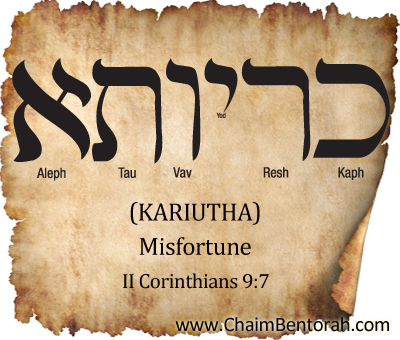
Aramaic Word Study – Misfortune – Kariutha כריותא Kap Resh Yod Vav Taw Aleph
II Corinthians 9:7: “Every man according as he purposeth in his heart, so let him give; not grudgingly, or of necessity: for God loveth a cheerful giver.”
This verse is not referring to a tithe. It is an offering. The Jews regularly gave offerings which were used as a sort of benevolent fund. There was no requirement as to what percentage of your income you were to give, this was an offering given from your heart. There was a bikkurim or the first fruits. Bikkurim is literally translated as promise to come. It was sort of an investment into their future acknowledging that God promised to supply their needs. It was a sacrificial offering given during the time of harvest. It usually totaled about six percent of the crop. When a farmer would go out to his field and find budding fruit, he would tie a reed around them and verbally declare them the first fruits. This applied only to seven species: wheat, barley, grapes, figs, pomegranates, olives and dates. The tithe was given to support the temple and priest hood and is no longer given as there is no longer a temple. The word tithe means ten and was considered like a tax or membership dues. Jews do not give a tithe today as there is no temple and the synagogue is not considered a temple. They collect dues from each member with special arrangements made for those who are financially unable to pay their dues.
Today we are under no obligation from God to give. If we belong to a church, we have an obligation to support that church, it’s building, maintenance and staff but it is not an obligation to give as a command from God. It is just a duty we owe to each other so we each pay our fair share to support a place we have chosen to worship God. We hear it over and over that the church is made up of people not a building.
Would you like Chaim Bentorah as your personal Hebrew teacher?
|
|
This brings us to our study verse. Paul is not referring to paying salaries or maintaining a building, he is referring to charities, helping the poor, widows, orphans, prisoners and others who are in need. Obviously, there were those who preferred not to give anything but gave because they were feeling some pressure to give, either peer pressure or pressure coming from subtle fears that others put on them like God not being pleased with them if they do not give or God will not bless them if they do not give. Paul is basically saying: “God is not twisting your arm to give. He owns the cattle on a thousand hills, He is not desperate or in need, He only wants you to learn the joy of giving.”
Some were giving grudgingly. The word grudgingly in Aramaic is kariutha which means pain, suffering and something else which may very well have been on Paul’s mind and why he would use this word. It also means misfortune. In other words, Paul is saying do not give offerings because you are suffering from some misfortune with the hopes that God will relieve your sufferings or misfortune. Many preachers use that subtle hint that if you are suffering from some misfortune that is bringing you pain either physically or emotionally and you give a generous gift to their ministry God will relieve this suffering of physical or emotional misfortune.
Paul doesn’t stop there he also exhorts us to not give out of necessity. The word necessity in Aramaic is patira which is the word for a conspiracy, a secret plan to commit something that is illegal. At the extreme end this would be like paying indulgences like the church instituted in the middle ages. In other words, the church needed to raise money so it decreed that anyone who would pay a certain amount of money could free a loved one from purgatory or even atone for a certain sin they themselves committed. One priest by the name of Tezel even had a little jingle; “For every penny in the coffer that pings another soul from purgatory springs.” There is also a story of a man who approach a priest for an indulgence for a sin he had not yet committed. The priest gave him absolution for this sin that was yet to be committed and later that day the man robbed the priest of all his money including the money he paid for his indulgence. That is what Paul meant by necessity or patira.
What Paul is saying is that we are not to give as a plot to manipulate or bribe God into giving us a blessing. We can’t bribe or manipulate God for a blessing. We are to give from what is purposed in our heart. The words purposed in our hearts in the Aramaic is bara’inah which has the idea of drawing close and/or bonding. In other words, your motive for giving an offering is to draw close to the heart of God so you may bond with Him. By helping others in need, you are bringing pleasure to God and this brings pleasure to you. It is just common knowledge that there is joy in giving, in helping others. We are to give whatever it is that brings us closer to the heart of God. We know we are giving with the right motive when we feel God’s pleasure.
This verse ends with God loves a cheerful giver. The word love is racham, the strongest deepest love that exist. The word cheerful is chadi, which means bright, shiny, cheerful and glad. In other words, God loves those who give out of pure joy with no ulterior motives, no bribing God, not giving to get a tax deduction or to win favor with someone. He gives just out of the pure joy of giving.
Hi there! Thank you for reading this Daily Word Study. Can I ask a favor? Share this Daily Word Study with your friends on Facebook and Twitter by clicking one of the icons below.
Thanks & Blessings, it means a lot to me!
STAY IN THE LOOP
Subscribe to our free newsletter.
Leave A Comment
Hebrew Word Study – A Passion – B’ir – Beth Ayin Yod Resh Song of Solomon 3:3, “The watchmen that go about the city found me: Saw ye him who my soul loveth?” “Ich bin ein Berliner” John F. Kennedy, June 26. 1963. Translation, “I am a jelly filled donut.” There is an urban legend

HEBREW WORD STUDY – (HEARING GOD’S) VOICE – QAVAL קול Exodus 19:5: Now therefore if you will obey my voice indeed and keep my commandments, Then you will be a peculiar treasure unto me above all the people, for all the earth is mine.” What caught my attention in this verse is the thought that
-
Hebrew Word Study – A Sensitive Nature – Pathah – Pei Taw Hei פתה Psalms 116:6: “The Lord preserves the simple, I was brought low and He helped me.” Hebrew Word Study – A Sensitive Nature – Pathah – Pei Taw Hei Psalms 116:6: “The Lord preserves the simple, I was brought low and He
WORD STUDY – ABBA אבא Mark 14:35-36: “And he went forward a little, and fell on the ground, and prayed that, if it were possible, the hour might pass from him. And he said, Abba, Father, all things are possible unto thee; take away this cup from me: nevertheless not what I will, but what