
by admin
Share
by admin
Share
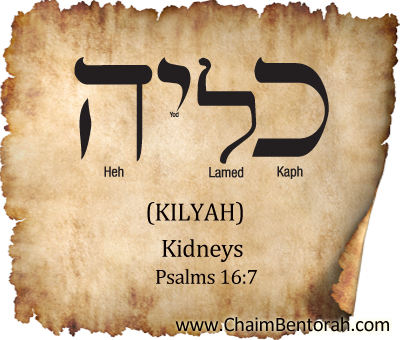
Hebrew Word Study – Kidneys – Kilyah כליה Kap Lamed Yod Hei
Psalms 16:7: “I will bless the LORD, who hath given me counsel: my reins also instruct me in the night seasons.”
When you examine this verse in the original Hebrew you discover some deeper meanings. The word bless is in a Piel (intensive form). The word bless is your predicate and it is followed by an eth, Aleph Taw which is he sign of the direct object which is the Lord. It is interesting to note that David refers to the Lord as YHWH. Although Bible Hub indicates that YHWH is in a masculine form, that is clearly not the case. The Qamats Hei at the end is a feminine ending. I can understand why we want YHWH to be in a masculine form as God is our Heavenly Father and Father is masculine. Yet, there is a reason why God’s name should have a feminine suffix. Traditionally, the father is usually the provider, the protector and the disciplinary in the family. The mother is traditionally considered the nurturer, the merciful, the loving and stabilizing influence in the family. “Wait until you father comes home” is a warning even sounded out today in many homes as the father is the one to be feared but trusted as the protector of the home.
God plays two roles, both mother and father. He is not only the protector, provider and disciplinary but He is also the one who is merciful, loving, nurturing and the stabilization in our lives. Jewish scholars note that God is referred to as either YHWH or Elohim. Modern liberal Bible critics say this is due to the fact that there were different authors who had different names for God. However, I side with orthodox Jewish scholars who teach that the interchange of names is to show the two roles that God plays in our lives, both male and female as Elohim is in a masculine form.
Would you like Chaim Bentorah as your personal Hebrew teacher?
|
|
There are times you will find God referred to as Lord/God or YHWH Elohim to reference His role as both Divine Mother and Divine Father. Sometimes He is known simply as Elohim to refer to Him as the protector, provider, and disciplinarian. Sometimes He is just referred to as YHWH as the loving, merciful, and nurturing parent.
So, in this verse, we have David who is going to bless the feminine role of God and do it in an intense way. The reason is that YHWH gives counsel. The word counsel is ya’ats which means to deliberate and make a decision. In other words, David is saying that he is consulting God and seeking His advice, and then making a decision. It is interesting the ya’ats is in a simple Qal perfect form. In other words, he is intensely blessing the Lord for not only His advice but with this word being in a perfect form he has applied this advice and the fact that he is intensely blessing the Lord indicates that this advice was pretty good advice.
This is followed by the conjunction ‘aph which means furthermore or in more modern English, on top of that or added to that. Beyond just getting good advice when David consults the Lord, the Lord also instructs his reins. We really don’t use the word reins much anymore as we associate it with a piece of tack that attaches to the bit that the horse has in its mouth. The reins are used by the rider on a horse to communicate with the horse to turn, stop or to guide the horse. Yet, this word in the 21st Century is one that not everyone understands because the average person no longer owns or rides a horse. Oddly the word reins is really an updated word for the Hebrew word kilyah which originally meant kidneys or your inward parts. The Talmud teaches that the word kilyah is a reference to that part of your body that carries your internal organs below your neck. This could include the stomach, liver, intestines, etc. but not your brain which is above your neck. This is where the real communication with God originates and it is filtered through the brain or mind. Many translations render this as your heart. Ultimately, the word reins for kilyah is a good rendering as God controls, communicates, guides tells us to turn or stop through our hearts, not our brains. It is our brains that filter out that command and if our minds are not stayed on God, we may just misinterpret those instructions.
That may be why David puts the word yatsar in a Piel-intensive form. The word is generally rendered as instruct but yatsar is also the word for discipline or chastise. In a Piel form, the word yatsar is more correctly rendered as chastising rather than instruct. It is, however a loving chastisement to correct behavior. It falls short of disciplinary action as it is associated with YHWH and not Elohim. This chastisement is associated with the feminine nature of God. It is a loving, merciful reprimand.
Note this comes in the night for it is in the night when we have no distractions and we are at rest. It is at this time that if we fail to hear God’s communication in our hearts during the daytime, He will revisit us at night when we are free from the distractions of the day and at rest and then deal with us in a loving, merciful way to correct our behavior. Do you ever have a dream or wake up in the middle of the night and say: “OMG, was I a fool, why did I do that, why did I not follow that still small voice this afternoon.” That may be God, YHWH gently yatsar or chastising you. He does His best to communicate with us, we just need to listen.
Hi there! Thank you for reading this Daily Word Study. Can I ask a favor? Share this Daily Word Study with your friends on Facebook and Twitter by clicking one of the icons below.
Thanks & Blessings, it means a lot to me!
STAY IN THE LOOP
Subscribe to our free newsletter.
Leave A Comment
Hebrew Word Study – A Passion – B’ir – Beth Ayin Yod Resh Song of Solomon 3:3, “The watchmen that go about the city found me: Saw ye him who my soul loveth?” “Ich bin ein Berliner” John F. Kennedy, June 26. 1963. Translation, “I am a jelly filled donut.” There is an urban legend

HEBREW WORD STUDY – (HEARING GOD’S) VOICE – QAVAL קול Exodus 19:5: Now therefore if you will obey my voice indeed and keep my commandments, Then you will be a peculiar treasure unto me above all the people, for all the earth is mine.” What caught my attention in this verse is the thought that
-
Hebrew Word Study – A Sensitive Nature – Pathah – Pei Taw Hei פתה Psalms 116:6: “The Lord preserves the simple, I was brought low and He helped me.” Hebrew Word Study – A Sensitive Nature – Pathah – Pei Taw Hei Psalms 116:6: “The Lord preserves the simple, I was brought low and He
WORD STUDY – ABBA אבא Mark 14:35-36: “And he went forward a little, and fell on the ground, and prayed that, if it were possible, the hour might pass from him. And he said, Abba, Father, all things are possible unto thee; take away this cup from me: nevertheless not what I will, but what