
by admin
Share
by admin
Share
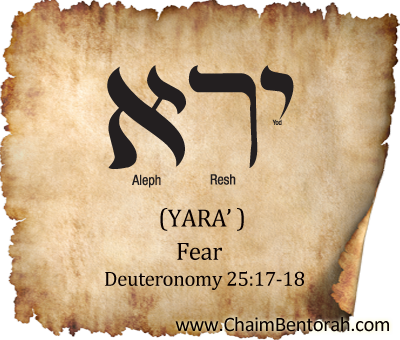
Hebrew Word Study – Fear – Yara’ Yod Resh Aleph
Deuteronomy 25:17-18: “Remember what Amalek did unto you by the way, when you came forth out of Egypt; (18) How he met thee by the way, and smote the hindmost of thee, even all that were feeble behind thee when thou wast faint and weary, and he feared not God.”
Amalek is believed to be the grandson of Esau and the son of Eliphaz. Esau was the brother of Jacob who stole his inheritance and was the sworn enemy of Israel. Amalak’s father was Eliphaz who was birthed from his concubine Timna and was raised in the household of Esau. Esau’s hatred for his brother Jacob, later named Israel, was passed on to Amalek and his offspring became the people of Amalek. They settled in the land south of Israel which is now known as the Negev Desert. Hamon the villain in the story of Esther was an Amalekite and was noted for his hatred of the Hebrew people and his plot to exterminate them. Stealing a birthright can really run deep. Not only that, this attack came right after the victory from crossing the Red Sea and Israel’s escape from the Egyptians.
What is really curious is why the Amalekites attacked Israel in the first place. The Amalekites were basically nomadic people who were noted bandits that attacked caravans for their supplies. They lived in relatively small bands and were not an organized nation. To attack a nation of thousands of people would be foolish. They were not trained warriors, just simply marauders. Even this Scripture teaches that they attacked only the innocent people who really did not have anything they would want or find useful.
For centuries rabbis have discussed the reasons for this attack against Israel and the only explanation they could come up with is just simple hatred of the Jews. A family feud that was centuries old resulted in an inbred hatred for the Jewish people. Plainly put, the Amalekites were the first antisemitic people on record.
Would you like Chaim Bentorah as your personal Hebrew teacher?
|
|
Here is what is really interesting. The people of Israel were told to just sit back and let God take care of the Egyptians. They did not have to raise a sword against the Egyptians, God handled the whole matter Himself and the people of Israel merely had to enjoy the show while they munched on their bagels. Yet, with the Amalekites they had to raise an army to go against them in the Name of the Lord. Why did God not take care of the Amalekites as He did with the Egyptians?
Perhaps we should go back a little further to the deliverance from Egypt. In Exodus 5:2: “And Pharaoh said, Who is the LORD, that I should obey his voice to let Israel go? I know not the LORD, neither will I let Israel go.” The problem with Egypt was not acknowledging God. Pharoah had no idea who Moses was talking about when he mentioned the name Jehovah or YHWH. So, God showed him who He was.
The Amalekites however knew full well who God was but according to Deuteronomy 25:18: “How he met thee by the way and smote the hindmost of thee, even all that were feeble behind thee, when thou wast faint and weary; and he feared not God.” The Amalekites did not fear God. The word fear in Hebrew here is yara’. This is not really a fear for one’s own safety. That is embodied in the word paqad which is a fear of terror, fright, and for the safety of one’s own gizzard. It is interesting that the English word fear, prior to the nineteenth century, really meant to show honor, respect and awe of another person or thing. As far as any personal fear it was the fear of offending someone or wounding their heart. It was Charles Darwin, of all people, who started to use the English word fear as a concern for one’s own welfare. When the King James Version uses the word fear it is to show respect and honor to God.
So, why did God not deal with the Amalekites as He did with the Egyptians? Perhaps it was to teach the Israelites to fear or yara’ God. One thing is clear, God fought against the Amalekites and won but he used an army of Jews to accomplish this victory. God expects us to stand up to the Amalekites that come across our path to destroy our faith. Our weapons are prayer, the Word of God, and the Love of God. Yet, fighting for our faith is something we must do.
I saw a picture on the internet the other day of a postal worker who was standing beside his postal truck, obviously having paused on his route to salute the American flag as a homeowner was raising it on his flag pole. This postal worker stood at attention saluting the flag as it was being raised. He was described as a veteran who had fought for his country. He yara’ our flag. The King James Version would translate that as fear but you and I know that this fear means he loves, honors, and respects his flag, so much that he paused to show that honor for the few moments it took to raise that flag. Why does this veteran love his flag? There are a number of reasons, but I can bet one main reason is that he fought for that flag, he laid his life on the line for that flag, he sacrificed for that flag, and boy you can bet he loves that flag and I pity anyone who dares to desecrate it front of him for I am sure he would overhaul their engine if they even tried.
Why does God want us in the fight for our faith and defend the name of God? Because, like that veteran, when we fight and sacrifice for our faith, we will only grow to love the God of our faith all that more. Sure, God can handle those Amalekites in our lives with one flick of his finger and we may be just a hang nail on that finger but He will use us to deal with them because when we do, we will be proud of our God, we will love Him all that more. We will learn to yara’ our God.
Hi there! Thank you for reading this Daily Word Study. Can I ask a favor? Share this Daily Word Study with your friends on Facebook and Twitter by clicking one of the icons below.
Thanks & Blessings, it means a lot to me!
STAY IN THE LOOP
Subscribe to our free newsletter.
Leave A Comment
Hebrew Word Study – A Passion – B’ir – Beth Ayin Yod Resh Song of Solomon 3:3, “The watchmen that go about the city found me: Saw ye him who my soul loveth?” “Ich bin ein Berliner” John F. Kennedy, June 26. 1963. Translation, “I am a jelly filled donut.” There is an urban legend

HEBREW WORD STUDY – (HEARING GOD’S) VOICE – QAVAL קול Exodus 19:5: Now therefore if you will obey my voice indeed and keep my commandments, Then you will be a peculiar treasure unto me above all the people, for all the earth is mine.” What caught my attention in this verse is the thought that
-
Hebrew Word Study – A Sensitive Nature – Pathah – Pei Taw Hei פתה Psalms 116:6: “The Lord preserves the simple, I was brought low and He helped me.” Hebrew Word Study – A Sensitive Nature – Pathah – Pei Taw Hei Psalms 116:6: “The Lord preserves the simple, I was brought low and He
WORD STUDY – ABBA אבא Mark 14:35-36: “And he went forward a little, and fell on the ground, and prayed that, if it were possible, the hour might pass from him. And he said, Abba, Father, all things are possible unto thee; take away this cup from me: nevertheless not what I will, but what