
by admin
Share
by admin
Share
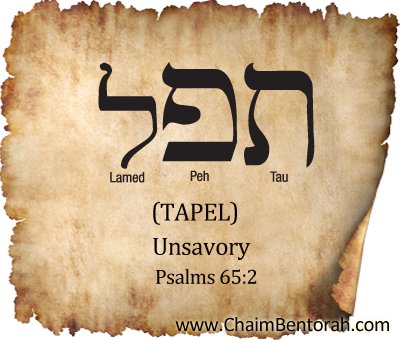
Hebrew Word Study – Unsavory – Tapel – Taw Pei Lamed
Psalms 65:2: “O you who hear prayer, to you all me will come.”
This word for hear is shama and is very difficult to translate as we really do not have an all-purpose English word to convey its intent. If we render it as hear that is not really expressing its true nature as that conveys the idea that God is listening but does not necessarily act on what he has heard. To render the word obey is more accurate only that gives the idea of being subservient. The word shama finds itself somewhere in the middle of this verse. Give me a word for a loving mother preparing for her child’s birthday party. The child is all excited about getting a birthday cake, ice cream, and a new video game. The child never questions that he will get a birthday party. To him the positive response to his request for a birthday party is just a given, he would be absolutely surprised if he did not get one. The only thing is that when the birthday party comes, instead of getting a birthday cake and ice cream he gets carrot sticks and celery, and when he opens his present in front of all his friends he finds it is not the latest version of a popular video game but a new pair of underwear. Give me a word for that and you have a good word for shama. God hears and answers every prayer according to this verse. However, we are so preoccupied with what we think the response should be we miss the answer entirely and think God did not hear or answer our prayer.
I found something intriguing in this verse. Why would the passage not say: “You who hear the prayer of all men will come to you in prayer.” Instead, this rendering suggests that all men will come to God but not all men will pray to God. If we take a closer look at the word used here for prayer you will see something very interesting. The root word for prayer is palal, which has the idea of interceding and supplication, ie., to earnestly and humbly plead as well as attach yourself to God.
Would you like Chaim Bentorah as your personal Hebrew teacher?
|
|
This gets complicated when we find that the word for man is basar which means flesh as many translations render it. Oddly the Psalmist did not use adam, gaval or ish which are the more common Hebrew words for man. Basar speaks of the inner part of the natural man. This is not the soul but one’s natural inner desires. It doesn’t take any stretch of the imagination that all people at some time or another in their lives come to God with petitions. Everyone will get themselves into some sort of bind where they inwardly call out to God with a petition. And this passage says that God hears and acts on all these petitions. Yet most people will testify that God has not acted upon all their petitions. Yet, this verse says that He does act on all petitions.
This is where we need to dig a little deeper into this word prayer. If we trace it to its Semitic root we find that prayer tends to be more than just calling out to God or talking to God. In its Semitic origins, it is a word for a tent peg. A tent peg serves a very important purpose to the tent, it keeps the tent firmly established in the ground so that it will not blow away at the slightest gust of wind. Now how did the word for a tent peg make its way to being used for prayer? Ancient Jews saw palal prayer as a means of attaching yourself to God. Just calling out to God is not prayer, that is calling out to God. Prayer is when you grab hold of God, attach yourself to Him in surrender, in humility admitting that you cannot accomplish your request within your own power, and then just hanging on to God like a tent peg holding onto the tent.
Many people call out to God but not everyone prays to God or attaches themselves to God. They just call out in desperation with no intention of establishing a relationship with Him. Note the unusual form that prayer is found in this verse. In this verse the form it takes is tepilah. The Psalmist is making a clever play on words here to accomplish a powerful lesson. You see tepilah can come from the root word palal for prayer or it can also take the root word tapel. Where palal has the idea of a sincere, humble petition and supplication to God, tapel carries the idea of unseasoned, unsavory, foolish or impiety. When we come to God it is in either one of two ways as palal or as tapel.
It doesn’t mean that God will not hear the tapel nor that He will not answer the tapel. Most the time, however, when He answers the tapel it is usually so selfish and self-centered that the one doing the tapel rather than palal won’t even realize his tapel has been answered.
Be sure to watch for my new book Palal, The Notch in The Tent Peg, my book on prayer to be released soon.
Hi there! Thank you for reading this Daily Word Study. Can I ask a favor? Share this Daily Word Study with your friends on Facebook and Twitter by clicking one of the icons below.
Thanks & Blessings, it means a lot to me!
STAY IN THE LOOP
Subscribe to our free newsletter.
Leave A Comment
Hebrew Word Study – A Passion – B’ir – Beth Ayin Yod Resh Song of Solomon 3:3, “The watchmen that go about the city found me: Saw ye him who my soul loveth?” “Ich bin ein Berliner” John F. Kennedy, June 26. 1963. Translation, “I am a jelly filled donut.” There is an urban legend
HEBREW WORD STUDY – (HEARING GOD’S) VOICE – QAVAL קול Exodus 19:5: Now therefore if you will obey my voice indeed and keep my commandments, Then you will be a peculiar treasure unto me above all the people, for all the earth is mine.” What caught my attention in this verse is the thought that
-
Hebrew Word Study – A Sensitive Nature – Pathah – Pei Taw Hei פתה Psalms 116:6: “The Lord preserves the simple, I was brought low and He helped me.” Hebrew Word Study – A Sensitive Nature – Pathah – Pei Taw Hei Psalms 116:6: “The Lord preserves the simple, I was brought low and He
WORD STUDY – ABBA אבא Mark 14:35-36: “And he went forward a little, and fell on the ground, and prayed that, if it were possible, the hour might pass from him. And he said, Abba, Father, all things are possible unto thee; take away this cup from me: nevertheless not what I will, but what