
by admin
Share
by admin
Share
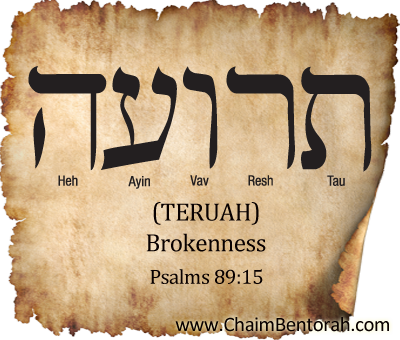
Hebrew Word Study – Brokenness Teruah – תרועה Taw Resh Vav Ayin Hei
Psalms 89:15: “Blessed [is] the people that know the joyful sound: they shall walk, O LORD, in the light of thy countenance.”
The Bible is full of people who are blessed. You are blessed if you study the Word of God, blessed is if you walk in the way of the Lord, blessed if we are meek, blessed if we are poor in spirit, blessed if you know that joyful sound…wait, back up. What is this joyful sound? The word in Hebrew is teruah and can have a wide range of meanings.
The NIV renders teruah as: “those who have learned to acclaim you.” Acclaim, what does that mean? It gets pretty bad if I have to go to Webster just to understand a modern translation. Anyways, Webster defines acclaim as sounds of joy. To be fair acclaim gives a more accurate nuance as it does carry the idea of a joyful approval. The Living Bible says; “Joyful call to worship.” That is entirely different than the NIV. The ESV just renders it as a festal shout. I cannot recall ever using the English word festal. So it is back to Webster, festal pertains to a holiday, that is altogether something different than the NIV and Living Bible. My bad, I was thinking in terms of, you know an infestation. The Contemporary English Version renders it as those: “who join in the festival.”: Net Bible says: “Those who worship you.” ISV – worship joyfully. Aramaic Bible in Plain English – “knows your glorious songs.” What songs? That is plain English? God’s Word Translation: “Know how to praise you.” That is the only one I can readily understand at first reading. Douray-Rheims Bible – “knows jubilation.” Well, it’s back to Webster again. Young’s Literal – “knowing the shout” back to square one, what is this shout all about?
Why not just say “Blessed are the people who praise you? The only problem with that is that teruah is not a word for praise and the verb to know has to fit in. Blessed are those who know how to praise you?” Is praise something we learn, a formula to follow, and after much experience, you really know how to praise? During worship services, I am convinced there are people who are worshipping and I can’t help but feel they are thinking: “Hey look at me, I am an experienced worship person, I know how to praise God, just follow my example and I will teach you.” Of course, our churches will send their worship leaders on an all-expense paid (some larger churches with expense accounts), trip to California to attend a worship leader’s conference where they will hope to glean some remnants of the Jesus Revolution and pick up some nifty worship techniques. You know something to really get the brethren excited so that they will have some spiritual manifestation. Some go to just get the basics like what is the difference between praise and worship. All will return with some of the latest hits in praise and worship music guaranteed to get the Spirit moving. Yet, when they return with all fresh new songs, they oddly sounds just like the songs we had been singing all along with a little “I like God” message. Of course, our proof text for the fact that we need to learn how to worship is our study verse, Psalms 89:15, which tells us that we must know how to praise or worship. Actually, a lot depends upon your English translation which suggests that this knowledge can only come from learning and teaching. Hence the need to attend a conference on worship and praise. Well, the word to know is not knowing from a learning experience, it is the word yadah which is an intimate knowing.
Would you like Chaim Bentorah as your personal Hebrew teacher?
|
|
In other words, a knowing that comes from experience and not head knowledge. I love it when translations differ in their renderings because I feel free to give my own rendering. This brings us back to this word teruah. The reason we have a problem with rendering it as praise is that there are many other words that clearly mean praise and worship, why did the Psalmist not use one of those words rather than a word which has an obscure rendering of worship or praise. Teruah comes from the root word ru’ which simply means to make a loud noise. I am not sure why that loud noise (mouth) that the mechanic who fixes my disability bus should be blessed. Another use from my lexicon is to become evil. That is not helpful at all. Yet, it does fit our mechanic which leads me to ask again: “Why should he be blessed?”
Ah, but here is one from my Jewish sources. Teruah is also used for brokenness or a broken heart. Ok, that fits me after my bus has been repaired and I am calling my dispatcher two days later from downtown Chicago asking for a tow truck.
But say, lookie here, Teruah is also used for making the sound of a trumpet or shofar during the time of the Jewish feasts. It seems Jewish commentators are just as all over the place with teruah as Christian commentators but at least they are all over the same place like they are putting together a jigsaw puzzle. They render teruah as a triumphant blast as a result of brokenness. What is the relationship between triumph and brokenness? The Midrash Tehillim (Psalms) 81:4 teaches that the words: “they will walk in the light of Your countenance or presence…” alludes to the days up to and through Rosh Hashanah and Yom Kippur. It is during this time that the sound of the shofar makes a series of broken blasts that mimic the sounds of sobbing from the depth of the heart. Guess what they call this little ritual. You’re right it is the Teruah. It is the sorrow or brokenness over your sins of the past year where you repent on Yom Kippur in sorrow and then rejoice or triumph over the remission of those sins giving you a Rosh Hashanah, a new year, a new life without those sins.
Hence, they render this as: “Blessed are the people who are intimate with a broken heart over their sins for they shall walk in the presence of the Lord.” Now that sounds like it comes right from the Sermon on the Mount.
Hi there! Thank you for reading this Daily Word Study. Can I ask a favor? Share this Daily Word Study with your friends on Facebook and Twitter by clicking one of the icons below.
Thanks & Blessings, it means a lot to me!
STAY IN THE LOOP
Subscribe to our free newsletter.
Leave A Comment
Hebrew Word Study – A Passion – B’ir – Beth Ayin Yod Resh Song of Solomon 3:3, “The watchmen that go about the city found me: Saw ye him who my soul loveth?” “Ich bin ein Berliner” John F. Kennedy, June 26. 1963. Translation, “I am a jelly filled donut.” There is an urban legend

HEBREW WORD STUDY – (HEARING GOD’S) VOICE – QAVAL קול Exodus 19:5: Now therefore if you will obey my voice indeed and keep my commandments, Then you will be a peculiar treasure unto me above all the people, for all the earth is mine.” What caught my attention in this verse is the thought that
-
Hebrew Word Study – A Sensitive Nature – Pathah – Pei Taw Hei פתה Psalms 116:6: “The Lord preserves the simple, I was brought low and He helped me.” Hebrew Word Study – A Sensitive Nature – Pathah – Pei Taw Hei Psalms 116:6: “The Lord preserves the simple, I was brought low and He
WORD STUDY – ABBA אבא Mark 14:35-36: “And he went forward a little, and fell on the ground, and prayed that, if it were possible, the hour might pass from him. And he said, Abba, Father, all things are possible unto thee; take away this cup from me: nevertheless not what I will, but what