
by admin
Share
by admin
Share
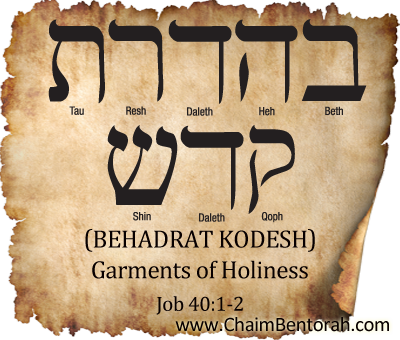
Hebrew Word Study – Garments of Holiness – Behadrat Kodesh Beth Hei Daleth Resh Taw Qop Daleth Shin
Psalms 29:2: “Give unto the Lord the glory due His name, worship the Lord in the beauty of holiness.”
Oh, how I love to quote this verse as I worship God. I just thrill when I utter the words to God that I am worshipping him in the beauty of His holiness. I get such a blessing from this that I actually hate to figure out what it means. Right now, I haven’t the foggiest idea what the beauty of His holiness means. But it sounds wonderful.
The word beauty in Hebrew is behadrat which means a garment. For this reason, commentators expressed the worship of God in a sanctuary or church where the priest and preachers wear beautiful robes and garments. In fact, it is this verse that serves the basis for priestly garments or robes worn by ministers in a church.
I was discussing this issue with one of my passengers on my disability bus today who is Catholic and attends Mass spoken in Latin. He informed me that His Latin teacher in High School promised to give him a passing grade if he promised never to take another Latin course. In other words, he can’t understand a word spoken in the service, but he feels he is worshipping God. I found myself agreeing with him and said, “You know, God is meant to be experienced not understood.” If my passenger happens to experience God in the beauty of His holiness who am I to say he is wasting his time sitting in a service where he cannot understand a word that is spoken. After all Jesus said that we worship God in spirit and my passenger’s spirit probably understands Latin.
There is one problem with applying this word behadrat to garments worn by men. It is speaking of the behadrat kodesh the garments of Holiness. When you look at the word holy or kodesh you find it means something sacred, consecrated, or set apart. I recently heard a rabbi speak on holiness and he said that somethings are naturally holy like the Torah and then there are somethings that are no holy like an idol. Most things are neutral that is neither holy nor unholy. It is for us to make it holy. Our computers are neither holy nor unholy. We have the choice to make them holy or unholy. We can make our computer holy by listening to worship music, writing blogs teaching the Word of God and we can make our computer unholy by watching pornography. A piece of cloth can be consecrated to God, used for purposes honoring God like wearing it to preach a sermon or unholy by wearing it to impress people with the fact that you are clergy and therefore someone special.
Would you like Chaim Bentorah as your personal Hebrew teacher?
|
|
I personally don’t see how wearing a robe will make a sermon more Godly but what do I know. I prefer to consider this garment of holiness or sacredness to be our physical lives, you know like our bodies are a garment for our spirit. Hence if we consecrate our bodies to God, then our bodies as the garment of holiness becomes holy. What would that mean for us? For one thing it would mean we could worship Him. Worship has two possible roots, shachah and/or sachah. I believe both apply here and it means shachah that is to physically bow before God and sachah to be surrounded by Him and His presence. When we have a life that is consecrated to Him he can surround us with his passionate love.I recently published a book entitled “Swimming in the Presence of God” which is a book on the Hebraic approach to worship. In researching for this book I interviewed worship
leaders in various churches of various denominations. Almost without exception when I interviewed a worship leader, I was really interviewing a music leader. We have come to associate music with worship. Some people are convinced that you cannot worship God without music and will even fire up an old battered boom box with a CD of worship music and try to get their group to worship God with that awful static filled sound that has music in there some place. To my Catholic friend worship is not music but the recitation of something in Latin. Although he does not know what he is saying he knows they are words of worship. To him worship is the reciting liturgy. I spoke with another person who spends hours in prayer and finds music very distracting. To her worship is prayer to God.
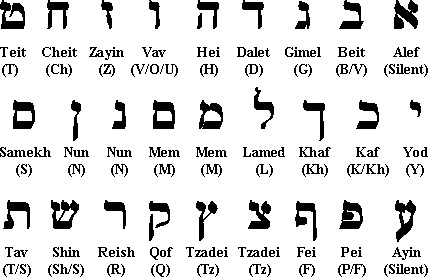
Note that the word kodesh which is the Hebrew word for worship is spelled with a Cheth. This letter represents a bonding and joining with God. The next letter is a Daleth which is a doorway or portal, that leads to the final letter the Shin which represents God’s passionate love. When we are holy before God, we can join or bond with Him so that He can open a portal to his passionate love. When that happens, sachah happens and we are immersed or surround by his loving presence.
Shachah and sachah comes from a Ugaritic word. In graduate school I translated a Ugaritic poem about a goddess Anat who fell in love with a mortal man. When that relationship was consummated, the word sachah was used, the very word that the Hebrew adopted to express what happens when we “worship” or sachah God. This does not mean a sexual relationship with God, but it does mean the deepest possible intimacy that we can experience with God.
Hi there! Thank you for reading this Daily Word Study. Can I ask a favor? Share this Daily Word Study with your friends on Facebook and Twitter by clicking one of the icons below.
Thanks & Blessings, it means a lot to me!
STAY IN THE LOOP
Subscribe to our free newsletter.
Leave A Comment
Hebrew Word Study – A Passion – B’ir – Beth Ayin Yod Resh Song of Solomon 3:3, “The watchmen that go about the city found me: Saw ye him who my soul loveth?” “Ich bin ein Berliner” John F. Kennedy, June 26. 1963. Translation, “I am a jelly filled donut.” There is an urban legend
HEBREW WORD STUDY – (HEARING GOD’S) VOICE – QAVAL קול Exodus 19:5: Now therefore if you will obey my voice indeed and keep my commandments, Then you will be a peculiar treasure unto me above all the people, for all the earth is mine.” What caught my attention in this verse is the thought that
-
Hebrew Word Study – A Sensitive Nature – Pathah – Pei Taw Hei פתה Psalms 116:6: “The Lord preserves the simple, I was brought low and He helped me.” Hebrew Word Study – A Sensitive Nature – Pathah – Pei Taw Hei Psalms 116:6: “The Lord preserves the simple, I was brought low and He
WORD STUDY – ABBA אבא Mark 14:35-36: “And he went forward a little, and fell on the ground, and prayed that, if it were possible, the hour might pass from him. And he said, Abba, Father, all things are possible unto thee; take away this cup from me: nevertheless not what I will, but what