
by admin
Share
by admin
Share
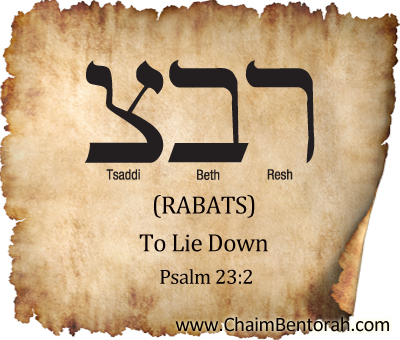
Hebrew Word Study – To Lie Down – Rabatz – Resh Beth Sade
Psalms 23:2: “He maketh me to lie down in green pastures: he leadeth me beside the still waters.”
Note: This is a study that will be found in my newest book A Hebrew Teacher Examines Psalms 23 Word by Word. It will be released around Christmas time so watch for it.
I wonder how many weary, worn-out Christians ever take a little time to meditate on these very familiar words that they have heard all their lives? We get the gist of this verse; God provides a place of rest for us in green pastures. That is curious, why does the Psalmist specify green pastures? Are not pastures green grass used for grazing animals? Also, what is this leading us to green pastures all about? Why does God have to lead us to green pastures? I think I am fully capable of finding a green pasture on my own. I know sheep need to be led to green pastures but, hey, I am a bit smarter than a sheep, why do I need God to lead me to green pastures? Sheep are led to green pastures to eat; however, we are being led to green pastures to lie down. For that matter why would I want to lie down in a green pasture which is filled with all those creepy, crawling things which include snakes, field mice and other such rodents that you do not care to meet face to face? On top of that it can get hot in this area of the world that is being addressed. Here in my hometown of Chicago, it is 90 degrees plus and I can barely breathe. Gnats, flies and mosquitos are in all their glory in pastures during a time like this. In my mind to get the real intent of this passage I would put it in these words: “He led me to a nice soft bed, in an air-conditioned room which has recently been visited by the Orkin man.” Now that is my idea of resting.
Since this whole idea of being led to green pastures to lie down has little appeal to me I feel justified by looking at possible alternative renderings. So, let’s start with the word lie. It is the word yarebitseni which comes from the root word rabats. Now the first thing I notice, because I am after all a Hebrew teacher, is that this word is in a Hiphal imperfect form. This is an event which is yet to happen. David is really saying “He will make me lie down.” I sense some resistance here. Maybe David is not too thrilled with all the creepy crawlies. Of course, as an old shepherd boy himself, I suppose he is used to the varmints. What would make him hesitate such that God would have to make him? Note this is a Hiphal form and that means it is causative. God is either forcing him to lie down or having to do some persuasion to get him to lie down. I mean when I got home from work today, which was an especially trying day, working in 90-degree, humid weather pushing wheelchairs and carrying groceries for the little old ladies (LOL’s we call them) and I saw that air conditioning, pest-free bedroom, God did not have to use the Hiphal on me to rabats. This old boy was ready and willing to lie down. If God had to use the Hiphal on me for anything it was to say; “Not yet old boy, remember we spend this time doing a Bible study together.” Even as I write this my body is crying out: “Sleep, sleep, I need sleep in a nice cool place.” As you may have guessed, it was no accident I chose this passage to study.
Would you like Chaim Bentorah as your personal Hebrew teacher?
|
|
Let’s look closely at this word for lie down, rabats. According to our lexicons, it means to lie down and to stretch out. It is derived from an ancient Persian word that was used for a newborn baby lying on its mother’s breast. An ancient and modern picture of complete contentment, peace, safety, and a source of nourishment. This may explain why the Psalmist felt he had to picture this pasture that you lie down in as green. The word green in Hebrew is desha’ which means green vegetation. Green is the ancient color for life. Did you ever walk into a Greenhouse, such a nourishing environment, you could feel the life around you? It is filled with life-giving oxygen because the green plants are taking in the carbon dioxide which is harmful to us and changing it into oxygen. To have that restful, peaceful environment in my air-conditioned, pest-free room, I would need to be surrounded by green plants that are well-watered. I see no problem in picturing an air condition room, pest-free, surrounded by the beautiful smell and oxygen-giving green plants to understand what the Psalmist is saying. I feel protected in my room, safe behind locked doors. To get to my apartment someone would need to get through a front door to the apartment building that is always locked, then an inner door which has another lock, and then my own door which has a lock, chain lock, and bolt (I mean I do live in Chicago). So, I feel about as safe as possible.
Perhaps that is the missing element in this verse. This may be why God must lead the Psalmist and cause him to lie down. I wouldn’t use the word make to lie down. I would rather use the word cause to lie down, it fits much better. If the Psalmist is David or a Chaim Bentorah, neither would feel very safe lying down in the green grass of Humboldt Park in Chicago, ground zero for crimes and murder. David would not feel safe lying down in green pastures as a king or when he was running for his life from King Saul and Absalom. Personally, if God wanted me to rest in the green grass of Humboldt Park, He would have to do a whole of “Hiphalling” -causing, and persuading until I was able to trust Him totally, completely without hesitation before I would be able to, rest peacefully like a baby in its mother’s arms.
In other words, God is doing all He can to build our trust in him to the point where we can just lie down during a time of any crisis, any fears, any problems. He is causing us to put all those fears, problems, and anxieties into His hands so that we can just rest like a newborn baby lying in its mother’s arms close to her breast.
We can be anywhere to find our “green pastures.” It doesn’t matter the dangers or perils that surround us. If God causes us to lie down and rest we are comfortably relaxing in His arms, safe from any dangers, pestilences, or harmful things.
Hi there! Thank you for reading this Daily Word Study. Can I ask a favor? Share this Daily Word Study with your friends on Facebook and Twitter by clicking one of the icons below.
Thanks & Blessings, it means a lot to me!
STAY IN THE LOOP
Subscribe to our free newsletter.
Leave A Comment
Hebrew Word Study – A Passion – B’ir – Beth Ayin Yod Resh Song of Solomon 3:3, “The watchmen that go about the city found me: Saw ye him who my soul loveth?” “Ich bin ein Berliner” John F. Kennedy, June 26. 1963. Translation, “I am a jelly filled donut.” There is an urban legend

HEBREW WORD STUDY – (HEARING GOD’S) VOICE – QAVAL קול Exodus 19:5: Now therefore if you will obey my voice indeed and keep my commandments, Then you will be a peculiar treasure unto me above all the people, for all the earth is mine.” What caught my attention in this verse is the thought that
-
Hebrew Word Study – A Sensitive Nature – Pathah – Pei Taw Hei פתה Psalms 116:6: “The Lord preserves the simple, I was brought low and He helped me.” Hebrew Word Study – A Sensitive Nature – Pathah – Pei Taw Hei Psalms 116:6: “The Lord preserves the simple, I was brought low and He
WORD STUDY – ABBA אבא Mark 14:35-36: “And he went forward a little, and fell on the ground, and prayed that, if it were possible, the hour might pass from him. And he said, Abba, Father, all things are possible unto thee; take away this cup from me: nevertheless not what I will, but what