by admin
Share
by admin
Share
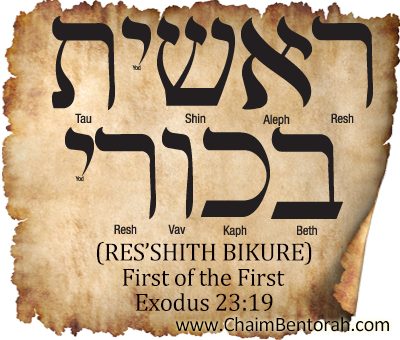
Hebrew Word Study – First of the First – Res’shith Bikure
Exodus 23:19: “The first of the first fruits of thy land thou shalt bring into the house of the Lord thy God, Thou shalt not seethe a yearling in his mother’s milk.”
The word fruit is thrown around a lot. “By their fruits, you shall know them…” We have the “fruits of the Spirit,” and the vine that does not bear fruit, etc. Fruit is an important word. It is quite important here as God is speaking of the first of the first fruits.
Fruit in Hebrew is parah which has the idea of offspring, or results, accomplishments. Hence we talk of the fruit or accomplishments of our labors. However, when Scripture speaks of the first fruits, it is using a different word. That word, as used in Exodus 23:19, is bokar. This has the idea of first or to be early. This specifically speaks of the first fruits. Traditionally the word bokar represented agricultural produce. The tradition of first fruits was not only practiced by the Hebrews but by the Greeks and the Romans as well. This was a form of taxation where the citizens brought the first of their produce to the temple or governmental hall where it was sold and the proceeds were used to pay wages, the light bill, etc. In the same way the Book of Exodus refers to a tithe (tax) to support the temple. So why the bokar (first fruits) and not just the parah (results, fruit)? This passage could have said to bring the rosh of the parah, which means just the first of the fruits, but instead, it says the rosh of the bokar, which would be the first of the first fruit. In other words, this is a reference to the best of the first fruits, the best of the best. This is followed by the command that the yearling goat was not to be boiled in it’s mother’s milk. That sounds odd, yet it is very specific.
Would you like Chaim Bentorah as your personal Hebrew teacher?
|
|
I wonder if Paul did not have this passage in mind when he wrote I Corinthians 15:22-23: “But as in Adam all die, even so in Christ shall all be made alive. But every man in his own order: Christ the firstfruits; afterward they that are in Christ at his coming.”
The yearling was a gedi, which is a goat. It is suggested that this is the goat that was brought before the High Priest on Yom Kippur. Two goats were brought before the High Priest actually. A lot was thrown and the winner was taken and thrown off a cliff, this was known as the scapegoat. The other goat was sacrificed as a sin offering. It is believed that this goat that was sacrificed is the gedi which was not to be boiled in its mother’s milk.
I would suggest that this is a picture of Jesus who was the first and the best of the first fruits, the best that God had to offer us, and like the goat in Exodus, he was sacrificed as a sin offering for us. And what does the idea of not being boiled in its mother’s milk represent? Most commentators believe it was a prohibition against an idolatrous practice in Egypt where at the end of their harvest they would boil a goat in its mother’s milk and then sprinkle the broth as some sort of ritual which would bring about a more productive harvest the next year. That would make sense for that point in time as the Hebrews needed to distance themselves from the idolatry of Egypt, but why continue the practice today when such things are forgotten?
If I am right and this is a Messianic picture, maybe God is trying to suggest something about the future Messiah being born of a virgin and that God is going to bring about a fruitful harvest of souls from the sacrifice of the Messiah who will be uniquely and divinely conceived? Or maybe I am just a dusty old professor trying to make some quantum leap.
Hi there! Thank you for reading this Daily Word Study. Can I ask a favor? Share this Daily Word Study with your friends on Facebook and Twitter by clicking one of the icons below.
Thanks & Blessings, it means a lot to me!
STAY IN THE LOOP
Subscribe to our free newsletter.
Leave A Comment
Hebrew Word Study – A Passion – B’ir – Beth Ayin Yod Resh Song of Solomon 3:3, “The watchmen that go about the city found me: Saw ye him who my soul loveth?” “Ich bin ein Berliner” John F. Kennedy, June 26. 1963. Translation, “I am a jelly filled donut.” There is an urban legend
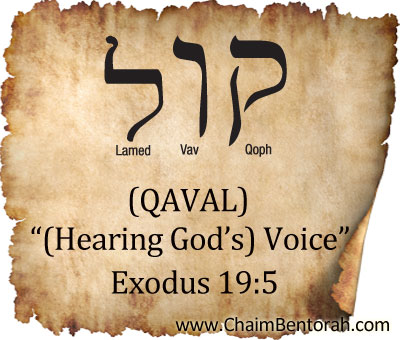
HEBREW WORD STUDY – (HEARING GOD’S) VOICE – QAVAL קול Exodus 19:5: Now therefore if you will obey my voice indeed and keep my commandments, Then you will be a peculiar treasure unto me above all the people, for all the earth is mine.” What caught my attention in this verse is the thought that
-
Hebrew Word Study – A Sensitive Nature – Pathah – Pei Taw Hei פתה Psalms 116:6: “The Lord preserves the simple, I was brought low and He helped me.” Hebrew Word Study – A Sensitive Nature – Pathah – Pei Taw Hei Psalms 116:6: “The Lord preserves the simple, I was brought low and He
WORD STUDY – ABBA אבא Mark 14:35-36: “And he went forward a little, and fell on the ground, and prayed that, if it were possible, the hour might pass from him. And he said, Abba, Father, all things are possible unto thee; take away this cup from me: nevertheless not what I will, but what