
by admin
Share
by admin
Share
Hebrew Word Study – Inside – tavek – תָּוֶךְ Taw Beth Kap
Exodus 25:8: “And let them make me a sanctuary; that I may dwell among them.
Tomorrow, in our Torah study online class on Zoom, we will address an interesting question. This is a question asked by Rabbi Jonathan Sacks, the former chief rabbi of the UK. He explained that there were only 31 verses to describe the entirety of the act of creation by God. Yet, when it comes to describing the building of the Tabernacle, it goes on and on for hundreds of verses.
I personally extend this question as a Gentile to ask why the tabernacle is mentioned at all. It doesn’t even exist today, and what value is there to know and understand the intricate details of every object, its size, shape, and material it is made out of? Let’s just get on with some information on the miracles of God and how he protected and blessed his people. After all, isn’t that why we read the Bible in the first place, to learn all the goodies that God wishes to bless us with?
I believe Exodus 25:8 is our key to understanding why the tabernacle is important to us as 21st-century Gentile Christians. God is saying that he was a sanctuary that he may dwell among THEM. The word among them is b’tocham, which is a third-person masculine plural and appears to be grammatically incorrect. Sanctuary, the subject of the sentence, is singular. The pronoun “them” is the predicate and is plural. In Hebrew, the number of the subject must match the predicate.
Would you like Chaim Bentorah as your personal Hebrew teacher?
|
|
This grammatical anomaly is to tell us that God did not just dwell in the tabernacle but also among His people as well. In fact, the word b’tocham comes from the root word tavek, which means not only among, but in the midst of, and is used 9 times in the Old Testament for inside. God wanted this tabernacle as a platform to enter into the very lives and physical bodies of His people. God may be everywhere, but He is omnipresent and will live inside each one of us, provided we invite Him into our lives. He won’t if we do not invite Him, it has to be our choice, and that is why hundreds of verses are devoted to the platform for God to enter our bodies and just 31 verses for the creation. Living inside us is far more important to God than the world and universe He created.
How is all this possible? Why a platform? What is the platform today, and how does it relate to the tabernacle? That we will discuss tomorrow morning in our Torah study. I would really hope that you consider joining us. All live meetings are also recorded to view at any time. You can sign up at www.hebrewwordstudy.com
Hi there! Thank you for reading this Daily Word Study. Can I ask a favor? Share this Daily Word Study with your friends on Facebook and Twitter by clicking one of the icons below.
Thanks & Blessings, it means a lot to me!
STAY IN THE LOOP
Subscribe to our free newsletter.
Leave A Comment
-
Hebrew Word Study – A Passion – B’ir – Beth Ayin Yod Resh Song of Solomon 3:3, “The watchmen that go about the city found me: Saw ye him who my soul loveth?” “Ich bin ein Berliner” John F. Kennedy, June 26. 1963. Translation, “I am a jelly filled donut.” There is an urban legend
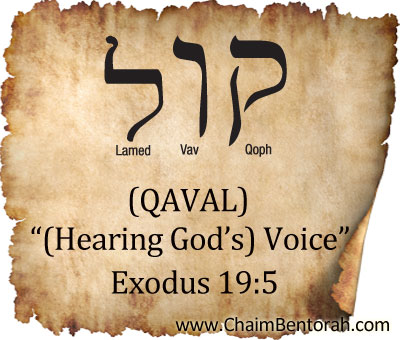
HEBREW WORD STUDY – (HEARING GOD’S) VOICE – QAVAL קול Exodus 19:5: Now therefore if you will obey my voice indeed and keep my commandments, Then you will be a peculiar treasure unto me above all the people, for all the earth is mine.” What caught my attention in this verse is the thought that
-
Hebrew Word Study – A Sensitive Nature – Pathah – Pei Taw Hei פתה Psalms 116:6: “The Lord preserves the simple, I was brought low and He helped me.” Hebrew Word Study – A Sensitive Nature – Pathah – Pei Taw Hei Psalms 116:6: “The Lord preserves the simple, I was brought low and He
WORD STUDY – ABBA אבא Mark 14:35-36: “And he went forward a little, and fell on the ground, and prayed that, if it were possible, the hour might pass from him. And he said, Abba, Father, all things are possible unto thee; take away this cup from me: nevertheless not what I will, but what