by admin
Share
by admin
Share
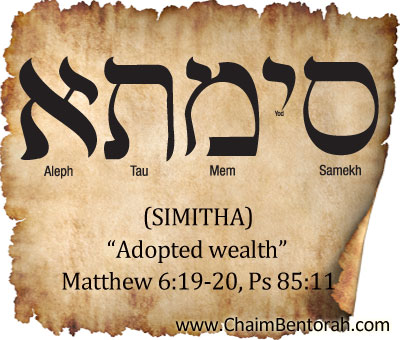
ARAMAIC WORD STUDY – ADOPTED WEATH – SIMITHA סימתא Samek Yod Mem Taw Aleph
Matthew 6:19-20: “Lay not up for yourselves treasures upon earth, where moth and rust doth corrupt, and where thieves break through and steal: (20) But lay up for yourselves treasures in heaven, where neither moth nor rust doth corrupt, and where thieves do not break through nor steal:”
Ps 85:11 Truth shall spring out of the earth, and righteousness shall look down from heaven.
“When truth will sprout from the earth, charity will peer from heaven” Talmud Bava Batra 11a
After Judas Maccabeus defeated the Seleucid army during the Maccabean Revolt in 167 BC there began a period of Jewish independence. In 140 BC the Hasmonean Empire ruled Palestine for 103 years, a time when the Jews enjoyed the freedom to worship with the second temple and Aramaic became the official language of Israel with Biblical Hebrew remaining as a ceremonial language. It was during this time that a great famine came across the land and the Hasmonean king Munbaz depleted his own personal wealth or treasures and that of his family and ancestors to provide for those in need. His family members banded against him and protested claiming that he squandered the family’s wealth. To them, King Munbaz replied: “Our ancestors stored below (in the physical world) whereas I have stored on High.” He then quoted from the Traditions of the Father later recorded in the Talmud Bava Batra 11a “When truth will sprout from the earth, charity will peer from heaven” This phrase is birthed from Psalms 85:11.
When Jesus walked the earth it was a little more than a hundred years after this event in the history of the Jewish people. This makes the event no more distant to the Jewish people of the first century as the Civil War is to us today. The words of King Munbaz were as celebrated as the words of Abraham Lincoln in the Gettysburg Address are celebrated today or even the words of our founding fathers in the Declaration of Independence: “We hold these truths to be self-evident, that all men are created equal.”
Would you like Chaim Bentorah as your personal Hebrew teacher?
|
|
It is believed that In Matthew 6:19-20 that Jesus was merely restating the words of the Tradition of the Fathers (The Talmud) which were restated by King Munbaz which had its origins in Psalms 85:11. The message still rings very clear today, “You can’t take it with you, so use it now.”
The word used for truth in this passage in Hebrew is amen which means to certainty or steadfast and is a play off the Qal imperfect form of the word which is identical to the word muth for death which is a certainty. When death springs from the earth love will come from heaven. In other words, when Jesus said, “Lay not up for yourselves treasures on earth He was not saying we should not have material things on earth, but He was telling us to die to those things, to be ready at any moment to give them up for the sake of others. Jesus was most likely making a reference to King Munbaz who was very wealthy when his people were starving to death. He saw his wealth as an opportunity to save his people. His family did not see it that way and felt he should have kept that wealth in the family. However, he clearly explained that his family’s treasures were not laid upon earth to gather dust, let moths eat it up or let it rust. It was meant to be used.
In Aramaic, the word treasure is simitha which is really a word for adoption. In other words, Jesus is telling us that whatever wealth we have is not really our own, God only let us adopt it. As one who adopts a child, they love it, care for it, nurture it to maturity and then send that grown child off to bring joy and comfort to others in the world. So too God has allowed us to adopt any wealth we have to raise it, nurture it and then send it out to bring joy and comfort to others.
Hi there! Thank you for reading this Daily Word Study. Can I ask a favor? Share this Daily Word Study with your friends on Facebook and Twitter by clicking one of the icons below.
Thanks & Blessings, it means a lot to me!
STAY IN THE LOOP
Subscribe to our free newsletter.
Leave A Comment
Hebrew Word Study – A Passion – B’ir – Beth Ayin Yod Resh Song of Solomon 3:3, “The watchmen that go about the city found me: Saw ye him who my soul loveth?” “Ich bin ein Berliner” John F. Kennedy, June 26. 1963. Translation, “I am a jelly filled donut.” There is an urban legend

HEBREW WORD STUDY – (HEARING GOD’S) VOICE – QAVAL קול Exodus 19:5: Now therefore if you will obey my voice indeed and keep my commandments, Then you will be a peculiar treasure unto me above all the people, for all the earth is mine.” What caught my attention in this verse is the thought that
-
Hebrew Word Study – A Sensitive Nature – Pathah – Pei Taw Hei פתה Psalms 116:6: “The Lord preserves the simple, I was brought low and He helped me.” Hebrew Word Study – A Sensitive Nature – Pathah – Pei Taw Hei Psalms 116:6: “The Lord preserves the simple, I was brought low and He
WORD STUDY – ABBA אבא Mark 14:35-36: “And he went forward a little, and fell on the ground, and prayed that, if it were possible, the hour might pass from him. And he said, Abba, Father, all things are possible unto thee; take away this cup from me: nevertheless not what I will, but what