
by admin
Share
by admin
Share
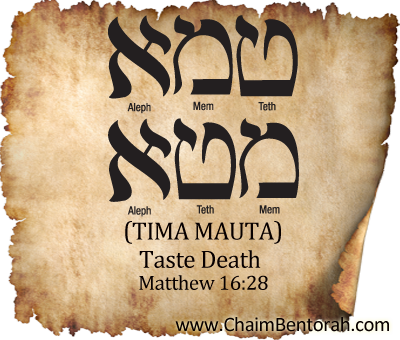
Aramaic Word Study – Taste Death – Tima Mauta Teth Mem Aleph Mem Teth Aleph
Matthew 16:28: “Verily I say unto you, There be some standing here, which shall not taste of death, till they see the Son of man coming in his kingdom.”
Reading this on a surface level can be very confusing. This appears to be talking about the second coming of Jesus but it is saying that there are some who are present with Jesus that will not die before his second coming. Well, what it really says is that they will not taste death. That is dying, isn’t it?
Commentators have struggled with this passage and generally conclude that Jesus only meant that they will see certain elements of the Son of Man coming into His kingdom, ie., the resurrection, the transfiguration, and the ascension into heaven. Bless their hearts, they really try to protect God’s Word. But, let’s face it, Jesus didn’t say that they would see a portion or a bit of the kingdom, He clearly meant the entire kingdom.
Others will look at the words taste of death and rightly conclude that it was a first-century idiomatic expression meaning one’s legacy. This could very well be true as the memory and legacy of the disciples are still with us today after 2,000 years and will continue to be known until Jesus returns. I have very little problem with that explanation as it seems to suggest that once Jesus returns with His kingdom then their legacy will end. I say a little problem because it would stand to reason that once Jesus returns the message of the disciples, hence their legacy will no longer have relevancy as the world that we know it will no longer exist, and the message of the disciples will have reached its fulfillment.
But let us look closer at these words taste of death. In Greek, the words are geusontai thanatou . Geusontai means to taste, experience, or partake. Thanatou is a separation of the soul from the body, it could be either spiritual or physical death. This could not be spiritual death as it is a reference to the disciples who would not die spiritually (or as we understand go to hell) once their soul is separated from their body. So it can only be a reference to physical death.
Jesus spoke these words in Aramaic and the Aramaic seems to shed some light on this passage. The Aramaic word for taste is taim. I searched through Jewish literature and found in the Targum some first-century understanding of this word taim. I found the word is actually used to express the value of what is eaten. There was an understanding in that day that certain foods were more healthy than other foods. Even in the day of Daniel certain foods were fed to Daniel and his friends because they were believed to create better health. When Daniel and his friends insisted on eating only kosher food the attendant was concerned that he would be put to death if he feed them something that left them looking very unhealthy. Once he discovered the taim or value of the kosher food, he fed it to everyone.
Thus, Jesus was saying “Verily I say unto you, There be some standing here, those who shall not see the value of death, till they see the Son of man coming in his kingdom.” Indeed, the disciples at the time of their death probably did not fully understand the value of the coming kingdom of God. Once after death time no longer exists. “One day with the Lord is as a thousand years” – II Peter 3:8. Once the disciples entered heaven, and stepped into that dimension where time no longer exists they saw the value of the Son of Man coming into His kingdom. In other words, they willingly gave up their lives for the sake of Jesus and the Gospel of the coming kingdom but it would not be until after they died would they realize the actual value of what they gave their lives up for.
Maybe we can put it another way. We fear death but will willingly go beyond our fear of death when we give our lives up for the sake of Jesus. It is not until after we die and enter the kingdom of God that we wonder why we so feared death. Some people cling to life hoping to never die when all along death is our doorway to something even greater and better. Thus some will not taste – taim – value death until they see the Son of man coming into his kingdom.
The Talmud teaches that a man can tell another person who has never eaten meat what meat taste like. He could use every possible description but until that person actually tastes meat himself, will he really fully understand what meat tastes like? The many martyrs throughout history only had an idea of what they were dying for but after they died did they really understand the full value of what they gave their lives for.
The word for death is mauta which, like the Greek, can mean either spiritual or Quphysical death. Possibly we can explain it another way if you hold to the theory that the kingdom of God belongs to those who accept Jesus as their Savior. Thus, until we die to ourselves, our fleshly, selfish earthly desires, and embrace the spiritual life offered by Jesus will we see the taim or the true value of the Son of man coming in His Kingdom of God.
Hi there! Thank you for reading this Daily Word Study. Can I ask a favor? Share this Daily Word Study with your friends on Facebook and Twitter by clicking one of the icons below.
Thanks & Blessings, it means a lot to me!
STAY IN THE LOOP
Subscribe to our free newsletter.
Leave A Comment
Hebrew Word Study – A Passion – B’ir – Beth Ayin Yod Resh Song of Solomon 3:3, “The watchmen that go about the city found me: Saw ye him who my soul loveth?” “Ich bin ein Berliner” John F. Kennedy, June 26. 1963. Translation, “I am a jelly filled donut.” There is an urban legend

HEBREW WORD STUDY – (HEARING GOD’S) VOICE – QAVAL קול Exodus 19:5: Now therefore if you will obey my voice indeed and keep my commandments, Then you will be a peculiar treasure unto me above all the people, for all the earth is mine.” What caught my attention in this verse is the thought that
-
Hebrew Word Study – A Sensitive Nature – Pathah – Pei Taw Hei פתה Psalms 116:6: “The Lord preserves the simple, I was brought low and He helped me.” Hebrew Word Study – A Sensitive Nature – Pathah – Pei Taw Hei Psalms 116:6: “The Lord preserves the simple, I was brought low and He
WORD STUDY – ABBA אבא Mark 14:35-36: “And he went forward a little, and fell on the ground, and prayed that, if it were possible, the hour might pass from him. And he said, Abba, Father, all things are possible unto thee; take away this cup from me: nevertheless not what I will, but what