
by admin
Share
by admin
Share
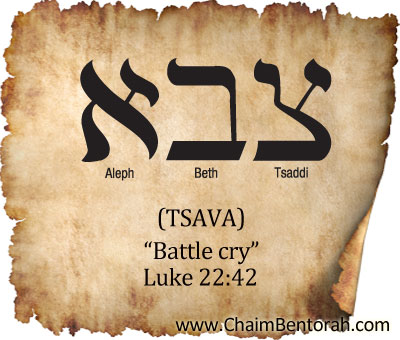
ARAMAIC WORD STUDY – A BATTLE CRY – TSAVA
Luke 22:42: “…nevertheless not my will by thine be done.”
“Forgive me Lord, I am weakening, I will not question your will.” General Lee’s prayer after learning that Longstreet could have been fatally wounded.
 I have a certain fascination for the Confederate General Robert E. Lee of the American Civil War. Lee was truly a man of God yet engaged in an occupation which would challenge his faith to its very core. General Lee’s most ablest Generals, Jackson, and Longstreet both were wounded by their own troops. In May of 1863, when General Jackson was wounded, General Lee admitted that he spent the entire night “wrestling” with God over Jackson’s life. He could not believe that God would take Jackson away from him at a time when he needed him the most. Yet, General Jackson died and Lee’s army suffered a crushing blow to their morale as Lee lost his best friend and associate. Almost one year to the date the other General (Longstreet) that Lee depended heavily upon was wounded. This time when General Lee received word that General Longstreet was not expected to recover from his wounds, he did not wrestle with God all night but simply gave General Longstreet over to God’s a “will.” Longstreet miraculously recovered from his wounds and was able to rejoin Lee in the fight against the Union army.
By 1864 General Lee had moved from believing in a God who provides a painless existence to a God who has a divine will and submission to this will is all important, painful or not. The year after General Jackson’s death there followed one defeat after another, for a year it seemed like God was not hearing General Lee’s prayers at all. General Lee realized God’s will was beyond his personal desires and had finally submitted to God’s will. Oddly, as the war drew to a close in 1864 and his ultimate defeat was becoming more apparent, General Lee only grew stronger in his faith. It would seem from some reports that he actually sparked a revival among his troops. All throughout the Confederate camps, there were small prayer groups. Men were giving their lives to Jesus, falling on the faces before God. It was not uncommon for the men to look up and see their General on his knees by his horse, Traveler, praying. It was not uncommon during Lee’s inspection of his troops that if he saw a group of men gathered together praying, he would dismount Traveler and walk over to the group, take off his hat and join them in prayer, The Commanding General with his officers and a circle of enlisted men all joined as one in prayer. Even today, the Southern States are known as the “Bible Belt.” I wonder if a humble Southern General from Virginia who suffered a crushing defeat and was declared a traitor to the United States, might not be responsible for bringing to this country a “Bible Belt.”
The word will used when Jesus was praying in the garden before his crucifixion in Luke 22:42 is thelema in the Greek which means desire, and choice. The Aramaic however, the language that Jesus spoke, uses the words tsevyana which means will or a willingness, however, it comes from a root word tsava’ which means to be delighted, pleasure or to approve. We do what brings delight, pleasure, and approval from God not what brings delight or pleasure to us with our personal approval.
Trace this word to its Canaanite origins we find it is a word used as a battle cry. Warriors preparing for war would declare their allegiance to their king by shouting tsava’ showing a willingness to give their life if necessary for their king.
As a rabbi, when Jesus prayed in the garden he intended for His disciples to be within earshot so they could listen to Him pray and learn from His prayer that it is really for God’s pleasure that they serve and that they should prepare for battle to tsava’ be willing to give up their lives if necessary for God. General Lee learned what the disciples eventually learned and that was to do what would bring pleasure and delight to God. Even in defeat General Lee was to be a good soldier. One hundred and fifty years later I believe we can see that God’s will was done. General Lee is up there in heaven right now with the full realization that it was not his will but God’s that was done and is glad he finally submitted to God’s will, pleasure or desire.
Too bad the disciples were asleep when their rabbi was teaching this lesson. Too bad General Lee was “asleep” in 1863 when he lost General Jackson. Too bad many of us are asleep when Jesus is trying to also teach us this lesson. We serve out of tsava’ to bring pleasure to our King.

STAY IN THE LOOP
Subscribe to our free newsletter.
Leave A Comment
Hebrew Word Study – A Passion – B’ir – Beth Ayin Yod Resh Song of Solomon 3:3, “The watchmen that go about the city found me: Saw ye him who my soul loveth?” “Ich bin ein Berliner” John F. Kennedy, June 26. 1963. Translation, “I am a jelly filled donut.” There is an urban legend

HEBREW WORD STUDY – (HEARING GOD’S) VOICE – QAVAL קול Exodus 19:5: Now therefore if you will obey my voice indeed and keep my commandments, Then you will be a peculiar treasure unto me above all the people, for all the earth is mine.” What caught my attention in this verse is the thought that
-
Hebrew Word Study – A Sensitive Nature – Pathah – Pei Taw Hei פתה Psalms 116:6: “The Lord preserves the simple, I was brought low and He helped me.” Hebrew Word Study – A Sensitive Nature – Pathah – Pei Taw Hei Psalms 116:6: “The Lord preserves the simple, I was brought low and He
WORD STUDY – ABBA אבא Mark 14:35-36: “And he went forward a little, and fell on the ground, and prayed that, if it were possible, the hour might pass from him. And he said, Abba, Father, all things are possible unto thee; take away this cup from me: nevertheless not what I will, but what