
by admin
Share
by admin
Share

ARAMAIC WORD STUDY – CEREMONIALLY UNCLEAN WOMEN – ANTTA אנתתא
I Corinthians 14:34: “Let your women keep silence in the churches: for it is not permitted unto them to speak; but [they are commanded] to be under obedience, as also saith the law.”
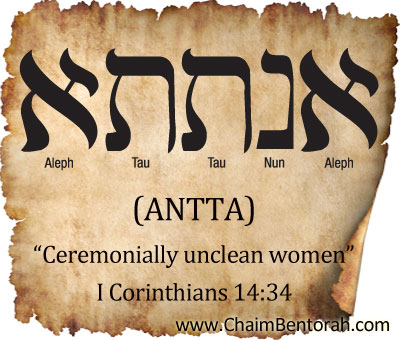 I was reading in the Talmud today and I ran across an Aramaic word I was not at all familiar with. It is the word antta. Antta is usually a pronoun you or your. The word for woman is not mentioned. Granted the Aramaic of the Talmud is not the same dialect that Paul spoke, but it is close. I searched this word out and found I was wrong to think it a pronoun. It is sometimes a pronoun Hebrew it is purely an Aramaic word for a woman or a wife. Thus it should be rendered “Let your women keep silent.” However, this is a particular type of women are women , one who is ceremonially unclean. That is women who are menstruating. They are considered unclean for seven days. Also, they are considered unclean for seven days after they have given birth.
I see two possibilities. One is that menstruation is a very private matter and it is information a woman is not likely to share with the church. Someone who is unclean could not participate in a religious service. But a normally talkative woman suddenly becoming silent in the church would be like shouting out to everyone, “Hey, everybody, it is that time of the month for me.” So for the sake of privacy, maybe Paul is suggesting all women keep silent. Then maybe a second possibility is that the ban on talking is simply for the ceremonially unclean woman.
Who says, this silent business means talking, teaching or preaching anyway? The word silent in the Aramaic is shetheq. It is from the same root as the word for drinking, that is drinking like water. You usually do not talk while drinking, but you also do not perform any other chores while drinking. Your focus is totally on satisfying your thirst. That was one of the tests Gideon used to determine a true warrior. The one who focused on just drinking water was not a true warrior. The one kept watch and did not focus on drinking water was the true warrior. Out of ten thousand, only three hundred turned their attention away from drinking water.
So menstruating women who are ceremonially unclean should focus on themselves and satisfying their thirst for God so to speak until the uneasiness passes. I suppose a woman could address this better but I am told menstruation is very uncomfortable filled with headaches, cramps etc. Maybe Paul is being compassionate here. You know sort of give the gal a break. She is not feeling well so don’t expect her to teach, preach or share if she is just not physically up to it. Maybe it is not a ban on women preaching, teaching, testifying etc., but just an expression of compassion for something men do not really understand.
STAY IN THE LOOP
Subscribe to our free newsletter.
Leave A Comment
Hebrew Word Study – A Passion – B’ir – Beth Ayin Yod Resh Song of Solomon 3:3, “The watchmen that go about the city found me: Saw ye him who my soul loveth?” “Ich bin ein Berliner” John F. Kennedy, June 26. 1963. Translation, “I am a jelly filled donut.” There is an urban legend

HEBREW WORD STUDY – (HEARING GOD’S) VOICE – QAVAL קול Exodus 19:5: Now therefore if you will obey my voice indeed and keep my commandments, Then you will be a peculiar treasure unto me above all the people, for all the earth is mine.” What caught my attention in this verse is the thought that
-
Hebrew Word Study – A Sensitive Nature – Pathah – Pei Taw Hei פתה Psalms 116:6: “The Lord preserves the simple, I was brought low and He helped me.” Hebrew Word Study – A Sensitive Nature – Pathah – Pei Taw Hei Psalms 116:6: “The Lord preserves the simple, I was brought low and He
WORD STUDY – ABBA אבא Mark 14:35-36: “And he went forward a little, and fell on the ground, and prayed that, if it were possible, the hour might pass from him. And he said, Abba, Father, all things are possible unto thee; take away this cup from me: nevertheless not what I will, but what