
by admin
Share
by admin
Share
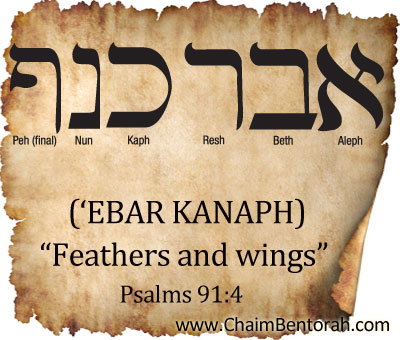
HEBREW WORD STUDY – FEATHERS AND WINGS – ‘Ebar Kanaph אבר כנף
Psalms 91:4: “He shall cover thee with his feathers and under his wings shalt thou trust. His truth shall be thy shield and buckler.”
 The word here for feathers is ‘ebar which is often associated with the feathers of a dove, although I have found it used to reference the feathers of an ostrich or eagle, generally, it is associated with a dove. This is interesting when you consider the habits of the dove. Both genders of the dove take turns sitting on the nest to hatch the eggs and when the eggs are hatched both will feed the young with what is called pigeon milk which both the male and female produce. They each work 12-hour shifts guarding the nest, never moving.
I think it is fitting that the Psalmist following the bird motif of Psalm 91 would reference the protection of its feathers. It takes two birds working in two shifts to guard their young but it takes only one God to lovingly watch over us 24/7. We have His undivided attention, He will not move from his guard post, we are under His constant surveillance. If there is any threat out there it has to go through Him before it ever reaches us.
The word ‘ebar for feathers comes from the Semitic root word ‘eber which means the feathers of a dove. However, it is rooted in the Akkadian word ‘abaru which is the word for being firm, fixed, strong, immovable. Hence I believe this word has its emphasis on not just the feathers of the dove but is a picture of the dove covering its young with its feathers and sitting over them, protecting them, being firmly planted over them and immovable. Jewish sages apply this word to the idea of covering for protection.
Rabbi Samson Hirsch related this word to the idea of a covering and concealing, hiding away. This creates the poetic connection to verse one where the Psalmist speaks of the secret place of the Lord dwelling in the shadow (of his wings) of the Almighty. Yet, Samson Hirsch also relates ‘eber to barar which means to cleanse and purify which poetically relates back to verse two and the reference to the chasah or refuge which also means an atonement.
We trust under His wings. Here is an unusual word for wings kanaph. The word for trust is chasah which means a refuge or atonement. So we find a refuge under His wings. Wings or kanaph has the idea of a skirt or the corner of a garment that flaps in the wind. Thus kanaph has the idea of a flapping of the wings.
It is under the flapping of His wings that we take refuge or find our atonement. Trust fits chasah here because our refuge and atonement are all based upon our trust in God. However, chasah is really the idea of a refuge and atonement with trust as the key to this refuge and atonement in our lives.
Kanaph flapping of wings comes from an old Persian word which has the idea of guards thrusting the people or objects they are protecting into a corner and then spreading their arms around the individuals or objects placing themselves as a human shield for their protection.
So we not only have a picture of God covering us and concealing us from danger if that danger does approach and discover us He will put us in a corner, spread His arms around us and be a Godly shield to protect us from that danger as it comes. I read in Jewish literature where kanaph has the idea of concealing from view. If an enemy approaches us, all he will see is God standing there, not us.
STAY IN THE LOOP
Subscribe to our free newsletter.
Leave A Comment
Hebrew Word Study – A Passion – B’ir – Beth Ayin Yod Resh Song of Solomon 3:3, “The watchmen that go about the city found me: Saw ye him who my soul loveth?” “Ich bin ein Berliner” John F. Kennedy, June 26. 1963. Translation, “I am a jelly filled donut.” There is an urban legend

HEBREW WORD STUDY – (HEARING GOD’S) VOICE – QAVAL קול Exodus 19:5: Now therefore if you will obey my voice indeed and keep my commandments, Then you will be a peculiar treasure unto me above all the people, for all the earth is mine.” What caught my attention in this verse is the thought that
-
Hebrew Word Study – A Sensitive Nature – Pathah – Pei Taw Hei פתה Psalms 116:6: “The Lord preserves the simple, I was brought low and He helped me.” Hebrew Word Study – A Sensitive Nature – Pathah – Pei Taw Hei Psalms 116:6: “The Lord preserves the simple, I was brought low and He
WORD STUDY – ABBA אבא Mark 14:35-36: “And he went forward a little, and fell on the ground, and prayed that, if it were possible, the hour might pass from him. And he said, Abba, Father, all things are possible unto thee; take away this cup from me: nevertheless not what I will, but what