
by admin
Share
by admin
Share
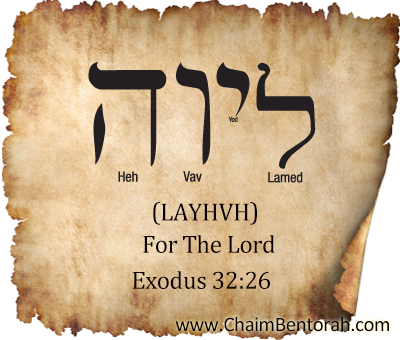
Hebrew Word Study – For The Lord – LaYHVH Lamed Yod Vav Hei
Exodus 32:26: “Then Moses stood in the gate of the camp, and said, Who is on the LORD’S side? let him come unto me. And all the sons of Levi gathered themselves together unto him.”
If you grew up in an evangelical or fundamentalist church you most likely sang a little song in Sunday School written by Frances R. Havergal in the nineteenth century – Who Is On The Lord’s Side. We then heard our Sunday School teacher tell the story how a reporter asked President Abraham Lincoln during the Civil War if the North was on the Lord’s side and President Lincoln answer: “Sir, the question should not be if we are on the Lord’s side but are we on His.” Yep, right up there with the story of George Washington as a child chopping down his father’s cherry tree and when confronted said; “Father, I cannot tell a lie, I did with the little ax you gave me for my birthday.” We cannot be sure if Lincoln ever said those words but, hey, like on famous screen writer said; “I don’t present history as it happened but as it should have happened.”
Apparently, Moses started this “who is on the Lord’s side” business in Exodus 32 when he returned from his mountain top experience in receiving the laws of God and found the people worshipping a golden calf. He stationed himself at the entrance to the camp of the Hebrews and declared: “Who is on the Lord’s side.” But, like with Abraham Lincoln, we are not sure that is what Moses really said. In the Hebrew what Moses said was; “Mi LaYHWH.” Literally, “who (is) for I Am.” I suppose the intent was to ask who is on the Lord’s side, but for me there is a little difference in nuance between who is on the side of the Lord and who is for the Lord. Sort of like saying: “Who is on the side of freedom.” Everyone will raise their hand, but if you ask who is for freedom, you might not get every hand because asking who is for freedom sounds more like a call to action and are you willing to put your life on the line for freedom.
Would you like Chaim Bentorah as your personal Hebrew teacher?
|
|
That is sort of like Charles Blondin the great tight rope walker in the nineteenth century who crossed Niagara Falls walking a tight rope. He walked back and forth thrilling a large audience. One day he announced to the audience: “Who believes I can walk across this tight rope with a man on my back. The audience was unanimous that he could do this. Of course, when he asked for a volunteer, no one would get on his back. He finally he had to persuade his manager Harry Colcord to climb on his back which he reluctant did and later who told reporters he was never so terrified in his life. Many were on the side Charles Blondin when it came to supporting him in carrying a man on his back while he crossed Niagara Falls on a tight rope but none were for Charles Blondin when asked for a volunteer.
Alright, I am cutting hairs, but here is where I am not cutting hairs. Moses asked: “Who (is) LaYHWH. He invoked the sacred name of God, a name that was not to be taken in vain. When used you must use it with intent. Usually, only a prophet would invoke that sacred name of God because when you did use that name, people listened. To use that sacred name of God in vain would be blasphemy and grounds for stoning. Even today Jews will not invoke that sacred name of God even though they are not sure how it is pronounced, they will not even risk using it and speaking its proper pronunciation. Who is for the creator and master of the Universe. Who is not on His side, but who is for Him, ready to take action for Him.
There is quickly coming a time when we can silently be on the Lord’s side, but to be for the Lord, that is, like the tribe of Levi to take action to protect His name, honor His name and even praise His name it may come with a price. It may call us to action. When we say we are “for the Lord” we are saying we are supporting everything that God demands and we will pay whatever price we must pay to bring Him honor and praise.
Hi there! Thank you for reading this Daily Word Study. Can I ask a favor? Share this Daily Word Study with your friends on Facebook and Twitter by clicking one of the icons below.
Thanks & Blessings, it means a lot to me!
STAY IN THE LOOP
Subscribe to our free newsletter.
Leave A Comment
Hebrew Word Study – A Passion – B’ir – Beth Ayin Yod Resh Song of Solomon 3:3, “The watchmen that go about the city found me: Saw ye him who my soul loveth?” “Ich bin ein Berliner” John F. Kennedy, June 26. 1963. Translation, “I am a jelly filled donut.” There is an urban legend
HEBREW WORD STUDY – (HEARING GOD’S) VOICE – QAVAL קול Exodus 19:5: Now therefore if you will obey my voice indeed and keep my commandments, Then you will be a peculiar treasure unto me above all the people, for all the earth is mine.” What caught my attention in this verse is the thought that
-
Hebrew Word Study – A Sensitive Nature – Pathah – Pei Taw Hei פתה Psalms 116:6: “The Lord preserves the simple, I was brought low and He helped me.” Hebrew Word Study – A Sensitive Nature – Pathah – Pei Taw Hei Psalms 116:6: “The Lord preserves the simple, I was brought low and He
WORD STUDY – ABBA אבא Mark 14:35-36: “And he went forward a little, and fell on the ground, and prayed that, if it were possible, the hour might pass from him. And he said, Abba, Father, all things are possible unto thee; take away this cup from me: nevertheless not what I will, but what