
by admin
Share
by admin
Share
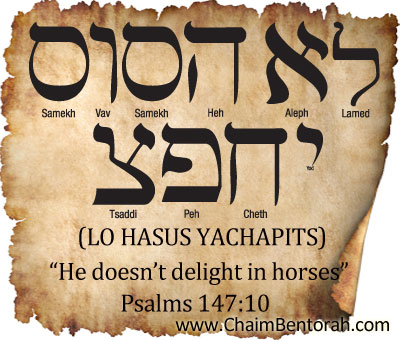
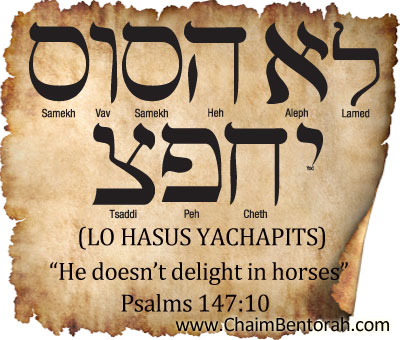
HEBREW WORD STUDY – HE DOESN’T DELIGHT IN HORSE – LO HASUS YACHAPITS לא הסוס יחפצ
Psalms 147:10: “He delighteth not in the strength of horses; he takes not pleasure in the legs of man.”
 I often have people ask me what a certain word really mean in Hebrew. That is an unfair question. Maybe for Greek, it is ok, but Hebrew, I need to know the verse they are referring to because unless I know the context I really can’t tell someone what that word means as one word in Hebrew can have a wide range of meaning. I may know its general use but I need to know the context. Many people will go to the back of their Strong’s Concordance or some Hebrew Dictionary and find the various usages of the word and still be at a total loss as to what the word really means. Instead of finding out what a word means, you must determine what it means in the context it is used.
The KJV renders Psalms 147:10 as “He delighteth not in the strength of horses, he takes not pleasure in the legs of man.” I have read a number of commentaries on this passage where the commentator suggest that horses were considered in that day to be the most beautiful animals in existence and the legs of a man that have been properly conditioned were a thing of beauty but Gods does not take pleasure in such natural beauty. The commentator is basically saying that God takes no pleasure in His creation.
I do challenge the renderings of three words: bigeburath from the root word gavar which is rendered as strength, the word yechepats from the root word chapats which is rendered as delight and the word yaretseh from the root word ratsah which is rendered as pleasure.
I would suggest that the word for delight“chapats in its context would suggest a bending toward or inclining before. In other words, God is not saying that He does not delight in the strength of a horse, but rather that He will not bend, incline or yield to the strength of horses. In context, I would not use gavar as strength but more like mastery or control over horses. Finally, I do not see God not taking pleasure over man’s legs, but I would view the word ratsah which is rendered as pleasure to be more like association.
Thus, I would respond to the KJV rendering by saying: “No, in context it would be more like: “I will not yield to the mastery or control over horses nor do I associate with the strength of man’s legs.”
David is faced with a threat from the Assyrian nation. The Assyrians have the most powerful army in the world. They were considered invincible because they had the strongest and largest war chariots than any other nation. They spent 20 years breeding horses that were powerful enough and wild enough to pull these chariots and about the same amount of time training warriors and building the leg and arm strength of warriors to control or master these horses so they could be the charioteers. David did not have the time to breed horses nor the warriors who had such strength in their legs to control these horses with a chariot.
I am not saying the KJV is in error in its translations for indeed, they have chosen English words which match the Hebrew words, but we must be aware that there are other options out there to choose from and the writers of the KJV version did not have the benefits of recent archeological discoveries which revealed the nature of the ancient Assyrian war horses and their chariots. Had they had 21st Century knowledge, I have no doubt they would have tweaked their translation and instead of using English words which suggest that God takes no pleasure in the beauty of horses and man’s legs, they would have used words which express that God will not yield even to the most powerful weapons on the face of the earth nor its strongest warriors.
So now in our Western 21st Century with nuclear-powered nations squaring off with their weapons we have a wonderful promise that God is not at all impressed with the weapons of these nations nor with their might and technological superiority. He is still in control and these weapons are no more a match for God that the chariots and warriors 3,000 years ago.
STAY IN THE LOOP
Subscribe to our free newsletter.
Leave A Comment
Hebrew Word Study – A Passion – B’ir – Beth Ayin Yod Resh Song of Solomon 3:3, “The watchmen that go about the city found me: Saw ye him who my soul loveth?” “Ich bin ein Berliner” John F. Kennedy, June 26. 1963. Translation, “I am a jelly filled donut.” There is an urban legend

HEBREW WORD STUDY – (HEARING GOD’S) VOICE – QAVAL קול Exodus 19:5: Now therefore if you will obey my voice indeed and keep my commandments, Then you will be a peculiar treasure unto me above all the people, for all the earth is mine.” What caught my attention in this verse is the thought that
-
Hebrew Word Study – A Sensitive Nature – Pathah – Pei Taw Hei פתה Psalms 116:6: “The Lord preserves the simple, I was brought low and He helped me.” Hebrew Word Study – A Sensitive Nature – Pathah – Pei Taw Hei Psalms 116:6: “The Lord preserves the simple, I was brought low and He
WORD STUDY – ABBA אבא Mark 14:35-36: “And he went forward a little, and fell on the ground, and prayed that, if it were possible, the hour might pass from him. And he said, Abba, Father, all things are possible unto thee; take away this cup from me: nevertheless not what I will, but what