
by admin
Share
by admin
Share
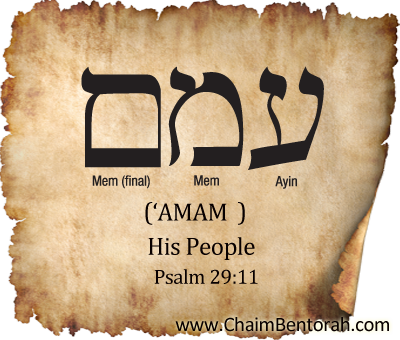
Hebrew Word Study – His People – Amam- Ayin Mem Mem
Psalm 29:11: “The Lord will give strength to His people and the Lord will bless His people with peace.”
In both cases where David says: “The Lord” he is using the name Jehovah or YHWH. YHWH is in a feminine form and expresses the feminine nature of God, the caring, loving, merciful, and nurturing nature of God. When David uses the name Jehovah (YHWH), he is doing so to express his intimacy with God. In fact, throughout this whole Psalm David is invoking the name Jehovah (YHWH) In ancient times pagan gods would be given various names but the true name of a god was usually not revealed. It was believed that the one who possessed the true name of a pagan god would be able to invoke that name and by invoking the true name of their pagan god they could snatch the power from that god. Yet in this Psalm David is invoking the true name of God and yet he is saying that His God will give him strength and peace, he does not have to snatch it from Him, there was nothing magic in invoking His true name. This is a Psalm of worship and in his worship, he is expressing the greatness of God. In this expression of God’s greatness, he concludes by bringing all of this to a personal level. This great, powerful, and mighty God will give his people strength and will bless them with peace. No magic formula’s no secret names, He will just give strength and peace.
The word strength is oz which I have discussed in earlier studies. This not only means to make one physically strong but also to make one courageous. The word before strength is nathan which means to give or impart. God will impart courage to His people.
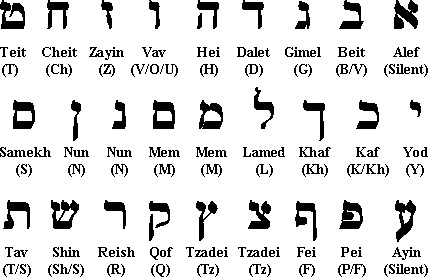
Who are His people? The word used here is interesting. David uses the word amam. This word basically means to be hidden or concealed. It also is used to express the idea of having something in common. Another use as a noun is rendered as people or kindred. Indeed, the word is spelled Ayin, Mem, and Final Mem. The Ayin represents inner reflection. The Mem represents the revealed knowledge of God and the Final Mem represents the hidden knowledge of God. His people are those who incorporate into themselves the revealed and hidden knowledge of God. A perfect example of this revealed and hidden knowledge is our salvation through Jesus Christ.
Would you like Chaim Bentorah as your personal Hebrew teacher?
|
|
For many, the first reaction in reading that God gives strength to his people is that David is referring to the Jewish people. Clearly, David’s use of the word amam shows that he is referring to not only the Jewish people but anyone who receives the revealed and hidden knowledge of God which culminates in the redemptive work of Jesus Christ.
So, if we are in Christ Jesus we are promised by God Jehovah to receive physical strength as well as courage to face whatever life will throw at us. Not only that, He will bless us with peace. The word bless is baruch which has a variety of meanings but in the context of this verse it has the idea of impartation. The Lord will impart peace to His people. Peace is the word shalom. Shalom also has a wide range of meanings. It involves not only a feeling of rest, but healing, protection, and shelter.
There is one rather unusual grammatical oddity here. The lack of conjunction. The word and is not in the Hebrew text in this verse. Hebrew loves its conjunctions. Where we would say in English: “I will go to church to pray, sing, worship, fellowship, and praise God.” In Hebrew, you would say: “I will go to church to pray and sing and worship and fellowship and praise God.” David’s lack of the conjunction as well as the multiple uses of the name Jehovah suggest that David is putting great emphasis on the fact that true courage and peace come from Jehovah alone. Jesus put it nicely when He said “My peace I give unto you, not that the world gives, give I unto you.” There is a peace you can get from the world, but it is not the peace of God.
A good example of David not practicing what he preaches is that we find that in the later years of his life, he calls for a census. He is facing threats from the Assyrians and it has him worried. Rather than rest on the courage and peace given by Jehovah, he conducts a census to see how big an army he can raise. Only God was to command a census. A census was important to God for He was numbering every individual, showing every individual was important to Him. If it was to raise an army it was to show that God was sending men off to war, not some human king, and that God was aware of each individual. Rather than really seek the courage and peace of God, David sought peace and courage in the natural world. Somehow just trusting in God was not enough, he also needed to know just how big an army he could raise, then he could feel some peace. So without God’s permission, he conducted a census. Of course, we all know how God felt about that and what happened to David as a result of seeking this courage and peace in the natural realm. Poor David, if only he would have practiced what he preached in Psalms 29:11.
But then, who am I to throw rocks at David, when I end up doing the same thing?
Hi there! Thank you for reading this Daily Word Study. Can I ask a favor? Share this Daily Word Study with your friends on Facebook and Twitter by clicking one of the icons below.
Thanks & Blessings, it means a lot to me!
STAY IN THE LOOP
Subscribe to our free newsletter.
Leave A Comment
Hebrew Word Study – A Passion – B’ir – Beth Ayin Yod Resh Song of Solomon 3:3, “The watchmen that go about the city found me: Saw ye him who my soul loveth?” “Ich bin ein Berliner” John F. Kennedy, June 26. 1963. Translation, “I am a jelly filled donut.” There is an urban legend

HEBREW WORD STUDY – (HEARING GOD’S) VOICE – QAVAL קול Exodus 19:5: Now therefore if you will obey my voice indeed and keep my commandments, Then you will be a peculiar treasure unto me above all the people, for all the earth is mine.” What caught my attention in this verse is the thought that
-
Hebrew Word Study – A Sensitive Nature – Pathah – Pei Taw Hei פתה Psalms 116:6: “The Lord preserves the simple, I was brought low and He helped me.” Hebrew Word Study – A Sensitive Nature – Pathah – Pei Taw Hei Psalms 116:6: “The Lord preserves the simple, I was brought low and He
WORD STUDY – ABBA אבא Mark 14:35-36: “And he went forward a little, and fell on the ground, and prayed that, if it were possible, the hour might pass from him. And he said, Abba, Father, all things are possible unto thee; take away this cup from me: nevertheless not what I will, but what