
by admin
Share
by admin
Share
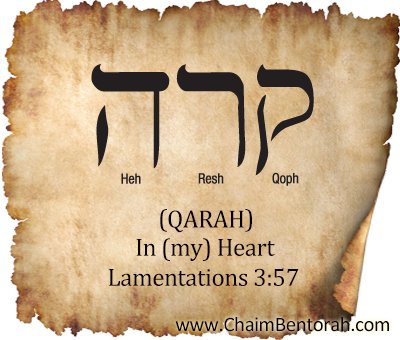
Hebrew Word Study – In (my) Heart – Qarah – Qop Resh Hei
Lamentations 3:57: “Thou drewest near in the day that I called upon thee, thou said: Fear not.“
I’ve attended many services where the preacher or worship leader talks about calling God into our presence, or that the Lord is especially near today. I can’t help but think, “Is not God omnipresent?” Isn’t he is near unto everyone not just to those who call upon Him. If He lives inside us then he is always near. I guess I really need to look further into this near business.
The word in Hebrew used here for near is qarav. There are really two different usages for this word. The first is to express the idea of nearness or closeness. The second is to express the idea of the inward parts, the bowels or the heart. Both words share identical consonants which are Qop, Resh, and Beth. So up until the 7th century AD it was pretty well left to the reader to decide if this meant that the Lord is near or is in the heart of those who call upon Him. Seven hundred years after Christ, the Masoretes came along, took Qop, Resh and Beth and made them into two separate words by putting a different vowel under the Resh. If the Resh has a pathah (short a) under it, then Qarah means near or being close, if it has a Qammets (long a) under it, Qarah means in the heart. For whatever reason, the Masoretes used a pathah and thus all our English translations follow in lock step and render this as near.
Would you like Chaim Bentorah as your personal Hebrew teacher?
|
|
For centuries the Masoretic text was the go to text and other sources were merely references and if there was a discrepancy the Masoretic text wins out. However, in recent years scholars studying the Dead Sea Scrolls came upon a startling conclusion. I mean this is big, big, big. But very little mention was made of it outside academic circles. What the scholars concluded was that from the Dead Sea Scrolls they discovered the Septuagint was more accurate than the Masoretic text. Well, I mean that was no new news for the Jewish rabbis, they always questioned the Masoretic text.
So, like a good rabbi, even though I am not, I am calling the Masoretic text into question on this point. I believe the word qarah should have a Qammets and not a Pathah and thus we should render this as “You were in my heart the day I called upon you.” I believe the Masorites should have used a long “a” and not a short “a.” Who am I to question the renown Mastorites? Well, I’m sorry but having God near is not good enough for me, I want Him in my heart and the original text, hundreds and hundreds of years before the Masoretes came along gives me the right to translate it this way.
This gets even better. Most our modern English translations plug in the word draw or come and render this passage as “the Lord drawing or coming near to me.” Yet, the word draw or come is no where to be found in the Hebrew text of this verse. In fact, the word Qarah (in my heart) is in a Qal perfect form. It should be rendered a completed action, “The Lord was in my heart when I called upon Him.” Curiously the Masoretes actually put it in a perfect (completed) form and here I agree. Most of our modern translations, for whatever, reason, tend to ignore the Masoretes at this point and give it an incomplete action. God figure.
For me this fits much better. At an early age I invited Jesus into my heart and He has been there ever since. He does not need to draw near to a place He already inhabits. When I call upon Him, He is already right there in my heart.
That brings up another issue, if He is right there in my heart why do I need to call upon him? The word for call is Qara’ which means to call or shout. But in its Semitic root is a call for a meeting or discussion. Jesus is in my heart 24/7. However, we are not always having a meeting, but if I become fearful, I just need to call a board meeting with the chairman of the board and CEO Jesus, explain my problem and he will say: “Fear not.”
When the chairman of the board and CEO says fear not, why should I fear, after all it is His corporation that will gone down the tubes. I signed all rights over to Him 50 years ago and he has kept my little corporation of body, soul and spirit chugging along just fine.
Hi there! Thank you for reading this Daily Word Study. Can I ask a favor? Share this Daily Word Study with your friends on Facebook and Twitter by clicking one of the icons below.
Thanks & Blessings, it means a lot to me!
STAY IN THE LOOP
Subscribe to our free newsletter.
Leave A Comment
Hebrew Word Study – A Passion – B’ir – Beth Ayin Yod Resh Song of Solomon 3:3, “The watchmen that go about the city found me: Saw ye him who my soul loveth?” “Ich bin ein Berliner” John F. Kennedy, June 26. 1963. Translation, “I am a jelly filled donut.” There is an urban legend
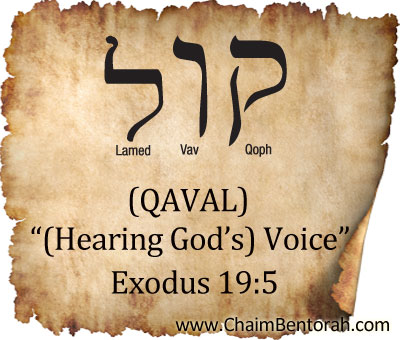
HEBREW WORD STUDY – (HEARING GOD’S) VOICE – QAVAL קול Exodus 19:5: Now therefore if you will obey my voice indeed and keep my commandments, Then you will be a peculiar treasure unto me above all the people, for all the earth is mine.” What caught my attention in this verse is the thought that
-
Hebrew Word Study – A Sensitive Nature – Pathah – Pei Taw Hei פתה Psalms 116:6: “The Lord preserves the simple, I was brought low and He helped me.” Hebrew Word Study – A Sensitive Nature – Pathah – Pei Taw Hei Psalms 116:6: “The Lord preserves the simple, I was brought low and He
WORD STUDY – ABBA אבא Mark 14:35-36: “And he went forward a little, and fell on the ground, and prayed that, if it were possible, the hour might pass from him. And he said, Abba, Father, all things are possible unto thee; take away this cup from me: nevertheless not what I will, but what