
by admin
Share
by admin
Share
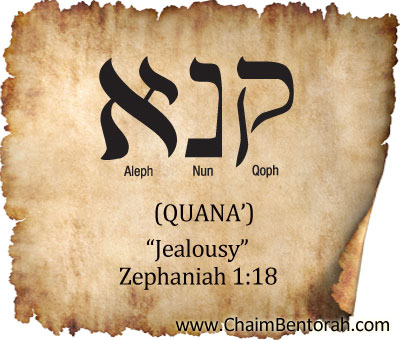
HEBREW WORD STUDY – JEALOUSY – QUANA’ קנא Qop Nun Aleph
Zephaniah 1:18: “Neither their silver nor their gold will be able to deliver them in the day of the Lord’s wrath. But the whole land will be devoured by the fire of his jealousy.”
“O’ beware, my lord of jealousy, for it is the green-eyed monster which doth mocks the meat it feeds upon. Shakespeare, Othello – Act 3, Scene 3.
Yesterday I wrote about the wrath of God and how we really need to analyze the Hebrew word which means a river overflowing its banks. We do not need to associate anger and rage with ‘avar which is rendered as wrath. The English word wrath carries a very negative connotation. I think the same can be said for being devoured by the fire of his jealousy.
In Shakespeare’s play, Othello, Othello’s servant sought to destroy his master by planting a seed of jealousy in the heart of Othello. Iago placed the handkerchief of Othello’s wife, Desdemona in Cassio’s, Othello’s lieutenant’s, room. Just a simple little thing, yet Iago knew that “trifles light as air is to the jealous confirmations strong as proofs of holy writ.”
Renaissance man had a much different view of the English word jealous than we do today. That is probably why the KJV used the word jealous when translating the Hebrew word quana. I have found that quana which is rendered as jealousy is used only in relationship with God. The English word jealousy has changed over the last 500 years and the understanding of the Hebrew word quana more closely fits the word jealousy at the time of Shakespeare than it fits our understanding of the word today.
There are two words in the Hebrew used for jealousy, quana and quanna. There is a big difference between the two. Iago tried to make Othello understand that he was feeling quana and not quanna. Quanna is a jealousy we think of when we hear the word jealousy. We associate it with envy and rage. This type of jealousy caused Othello to be caught between the jaws of affection and anxiety. It eventually led to the tragic end of the play. Yet, Renaissance man viewed jealousy as Ouana. Sometimes this word is translated as zealous. Yet, its very basic meaning is a deep passion. Jealousy was something considered noble to the Renaissance man. It showed how deeply he felt toward someone. To be jealous was a good thing because it showed you were so passionate toward someone or something that you would challenge someone to a duel and die to defend your passion or honor. Such a passionate person was to be honored and trusted. Today, of course, we see jealousy as a misdirected passion.
In the Shakespearian play, Hamlet, Shakespeare challenges this convention. Hamlet tells his close friend Horatio, “Give me that man that is not passion’s slave and I will wear him in my heart’s core, in my heart of heart as I do thee.” Here Shakespeare takes a pot shot at the conventions of his day. He is challenging the notion that a deeply passionate person is to be honored and respected by saying that if one is to trust another with the very center of his heart; it is best not to do it with one who is a slave to his passion.
In Hebrew quana’ means to burn with such passion for someone or something that you will not allow anyone to come close to your object of passion. I picture jealousy as someone grabbing hold of someone or something and saying; “Mine, all mine, everyone get away, no one can have what is mine.” What a nasty attitude, but you know if God wants to feel that way about me, I won’t object. Think about what you want, but I sure like the idea of having a jealous God. Not the quanna the violent passion of Othello, but he quana, the passion of the Renaissance gentleman. The one who cares so much for what he loves that he would die without it.
With quanna Othello killed Desdemona, with quana Othello would die defending Desdemona. I say Zephaniah 1:18 should be rendered: “The whole land will be devoured by the fire of His quana, (His passionate love for which He would die.)”
STAY IN THE LOOP
Subscribe to our free newsletter.
Leave A Comment
Hebrew Word Study – A Passion – B’ir – Beth Ayin Yod Resh Song of Solomon 3:3, “The watchmen that go about the city found me: Saw ye him who my soul loveth?” “Ich bin ein Berliner” John F. Kennedy, June 26. 1963. Translation, “I am a jelly filled donut.” There is an urban legend

HEBREW WORD STUDY – (HEARING GOD’S) VOICE – QAVAL קול Exodus 19:5: Now therefore if you will obey my voice indeed and keep my commandments, Then you will be a peculiar treasure unto me above all the people, for all the earth is mine.” What caught my attention in this verse is the thought that
-
Hebrew Word Study – A Sensitive Nature – Pathah – Pei Taw Hei פתה Psalms 116:6: “The Lord preserves the simple, I was brought low and He helped me.” Hebrew Word Study – A Sensitive Nature – Pathah – Pei Taw Hei Psalms 116:6: “The Lord preserves the simple, I was brought low and He
WORD STUDY – ABBA אבא Mark 14:35-36: “And he went forward a little, and fell on the ground, and prayed that, if it were possible, the hour might pass from him. And he said, Abba, Father, all things are possible unto thee; take away this cup from me: nevertheless not what I will, but what