by admin
Share
by admin
Share
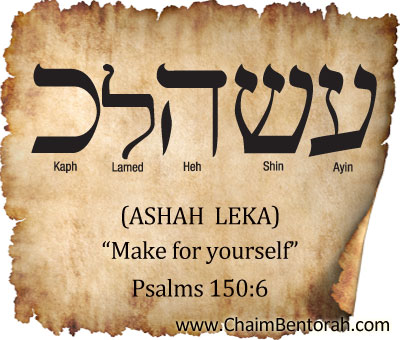
HEBREW WORD STUDY – MAKE FOR YOURSELF – ASHAH LEKA עשה לך Ayin Shin Hei Lamed Kap
“Exodus 20:4: “Thou shalt not make unto thee any graven image in the likeness that is in heaven above or the earth beneath, or that is in the water under the sea.”
Matthew 22:20-21: “And He said unto them, whose is this image and superscription? They say unto Him, Caesars. The saith he unto them “Render unto Caesars the things which are Caesars and unto God the things that are God’s.”
 There is much controversy over what Jesus meant in Matthew 22 and I do not intend to address that controversy. I am more interested in how Jesus managed to put the Pharisees in their place. The Pharisees and Herodians really thought they had Jesus trapped when they asked Him about paying taxes. You see the basic argument between the Pharisees and Jesus was the authority of the Tradition of the Father which later became the Talmud. Tradition carried as much weight as the Scripture or the Torah itself for the Pharisees and Jesus was trying to explain to them that the Torah comes from God (which they readily admit) but tradition is of man and not of God, which they also agreed to but for the fact that somewhere tradition taught them that if two or three are gathered together in agreement then what is bound on earth is bound in heaven. So if two or three rabbis agree on earth that you tithe ten percent of your gross income and not your net income then they bind that as law on earth, heaven will bind it and therefore it is a violation of the tithe to give only based upon your net. My, my what some pastors could do with that. But if two or three rabbis agree to lose you from you tithing obligation and the bind that on earth then that will be bound in heaven. My my what so church members could do with that.
Thus in this situation, it was bound on earth and therefore allegedly bound in heaven than to pay a tax was really tithing. The word tithe means ten and therefore to give 10% of your income to the government was a tithe. They reasoned that it was ok to pay 9%, that is not a tithe, or even 11% as that too is not a tithe. Unfortunately, the Roman government demanded 10% of your income and that was a tithe and therefore sinful as only 10% belonged to God.
However, in this situation, the Pharisees knew that Jesus had no objection to paying taxes which was not in violation of the Torah, the Scripture, but it was in violation of tradition which was considered as authoritative as the Scripture. So if Jesus said you should pay taxes, they would drag him off to the Sanhedrin to be tried as a heretic. If he said no you should not he would have to deal with the Roman soldiers who would likely arrest him for treason
Note in verse 18, Jesus calls them hypocrites. He then proceeds to back up his accusation with facts. He asks someone to produce a coin. I have a coin on my desk from that time which is called the Tribute Coin and likely like the coin the Pharisee produced. It bears the picture of Caesar Augustus Tiberius and the inscription “Caesar Augustus Tiberius, Son of the Divine Augustus.” To the Jew, this was blasphemous as it claimed that Caesar Augustus Tiberius was a god. Thus, to carry this coin with them was in violation of the second commandment as they interpreted the commandment. Jesus used their own Oral Tradition, their own spin on the Torah to corner them. The poor slob who shared his coin sort of forgot in his enthusiasm that he was admitting to idolatry as the Pharisees interpreted Exodus 20:4. Jesus busted him. But at the same time, Jesus put that commandment into its proper perspective. If the Pharisee accused Jesus of violating oral tradition, Jesus would accuse this Pharisee of the greater crime of violating the second commandment.
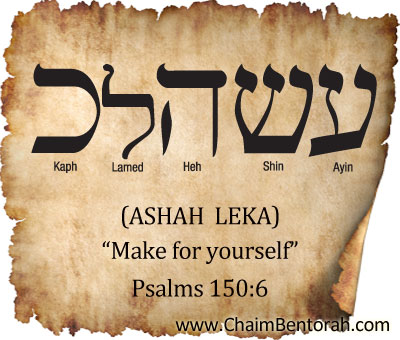
In Exodus 20:4 we are instructed not to make. The word is ashah which is followed by the word leka which means to you. Ashah leka has the idea of taking something unto yourself. You are not to take for yourselves any graven images. This word for graven image is pesel which means to carve out and fashion something that is seen. We are not to take upon ourselves anything that is fashioned to take on the representation or the likeness which is mun in Hebrew or physical manifestation of anything in the supernatural. In other words don’t depend upon the natural or what can been seen to do what God, the unseen, can and will do.
It does not appear this commandment is addressing all the paintings and sculptures we have of Jesus and the images that are made of Jesus. We have pictures of Him on the cross, healing the sick, raising the dead, etc. Exodus 20:4 is not addressing that. However, if you feel that if you touch a picture of Jesus healing someone and that you will be healed, then you have violated this commandment. But, if the picture is used to remind you that He is the source, then it does not fit Exodus 20:4. The key lies in the words Ashah leka to take unto yourself these graven images. In other words, to depend or pray to something you can see. You don’t pray to that picture or that image of Jesus, you pray to Jesus.
I believe the real point of this story reminds me of a pastor I knew who preached a wonderful sermon on smoking, dancing, movies, drinking and as terrible, horrible sins. He passed away a couple of years later in his forties from diabetes. He was grossly overweight. I don’t recall junk food and overeating included in his list of sins in that sermon.
STAY IN THE LOOP
Subscribe to our free newsletter.
Leave A Comment
Hebrew Word Study – A Passion – B’ir – Beth Ayin Yod Resh Song of Solomon 3:3, “The watchmen that go about the city found me: Saw ye him who my soul loveth?” “Ich bin ein Berliner” John F. Kennedy, June 26. 1963. Translation, “I am a jelly filled donut.” There is an urban legend
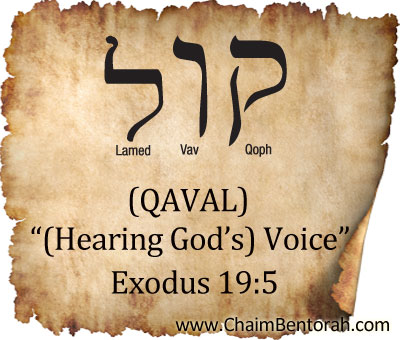
HEBREW WORD STUDY – (HEARING GOD’S) VOICE – QAVAL קול Exodus 19:5: Now therefore if you will obey my voice indeed and keep my commandments, Then you will be a peculiar treasure unto me above all the people, for all the earth is mine.” What caught my attention in this verse is the thought that
-
Hebrew Word Study – A Sensitive Nature – Pathah – Pei Taw Hei פתה Psalms 116:6: “The Lord preserves the simple, I was brought low and He helped me.” Hebrew Word Study – A Sensitive Nature – Pathah – Pei Taw Hei Psalms 116:6: “The Lord preserves the simple, I was brought low and He
WORD STUDY – ABBA אבא Mark 14:35-36: “And he went forward a little, and fell on the ground, and prayed that, if it were possible, the hour might pass from him. And he said, Abba, Father, all things are possible unto thee; take away this cup from me: nevertheless not what I will, but what