
by admin
Share
by admin
Share
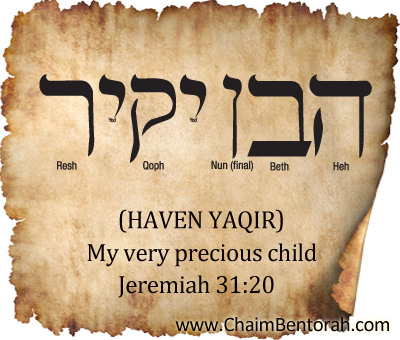
HEBREW WORD STUDY – MY VERY PRECIOUS CHILD – HAVEN YAQIR הבן יקיר Hei Beth Nun Yod Qop Yod Resh
Jeremiah 31:20 [Is] Ephraim my dear son? [is he] a pleasant child? for since I spake against him, I do earnestly remember him still: therefore my bowels are troubled for him; I will surely have mercy upon him, saith the LORD.
When I started to study this verse in the original Hebrew I was totally blown away. We can’t even begin to imagine what the love of God is like. It is beyond our human comprehension. It is a love that we in our human flesh with our fallen nature cannot even come close to having for God. After studying this verse I know, in a simple way understand, what a woman I drove in my disability bus some time ago shared. She told me how she was undergoing heart surgery when she died on the operating table. She said she was not necessarily a religious person before this experience and just figured when you died that was it, total non-existence. Your consciousness flutters out. But now she is convinced there is a life after death. The doctors told her that what she experienced was her brain’s desperate attempt to hang onto consciousness. She thought perhaps, the light, that feeling of euphoria, etc. could be just a hallucination but for one thing. She believed she met Jesus and when she did she felt a love flow from Him that was beyond anything she could even imagine. If it was a hallucination it would have to express feelings that she was familiar with. But this was a love she had never felt, a love beyond her ability to comprehend. She called it an “Amazing Love.” When the doctors brought her back they said she fought them demanding that they let her stay in this love. She was depressed for days after this longing to experience this Amazing Love again. But she took to heart, for she knew one day she would return to that Amazon Love. For now, she came back knowing that somehow she needs to let others know of this Amazing Love.
I have heard many former Christians say: “I tried Christianity, it didn’t work.” What did they mean it didn’t work? They did not get rich, prosperous when they paid their tithe? They were not healed, relationships were not restored, they didn’t get that good job?
The sound just like the people Jeremiah prophesied to. It was the Northern Kingdom which split in a civil war from the Southern Kingdom of Judah after the death of King Solomon. From the time of the civil war to their captivity the Northern Kingdom did not worship God Jehovah. They worshipped other Gods, they rejected the God of their fathers, they rejected the prophets. They even told Jeremiah: “When we worshipped God we were starving, we had war with other nations, but now that we worship the Queen of Heaven, well, things are really good now.” What they were saying was that they would worship the god that had the highest bid, that paid the best.
Jeremiah responded with the words straight from the heart of God in Jeremiah 31:20: He calls them Ephraim which means doubly fruitful. It is a name used to express his tender love for Israel. Then he calls them his dear son. The word dear is yaqir which means very precious. It is better rendered as my very precious children.
Then he calls this nation that used Him for their own advantage, rejects Him when the paychecks ceased when the payout was not good enough, He says that they are a pleasant child. The word pleasant is sha;asho’im. This word means to take delight and joy in something. This is a picture of a mother finding joy and delight in her little child as he plays.
“Therefore my bowels are troubled for him.” Ah, the beautiful poetic King James Version. No wonder the pilgrims fled from him. Troubled bowel is hamu me’i. This is translated by most Modern English translations as: “My heart yearns for them” which is not quite as gross sounding. However the word me’i does mean the bowels or inner organs of the body. It is also a word used for the womb. I do like the rendering of heart, however.
Still, that word me’i is a playoff the next words: “I will surely have mercy upon him.” Actually, it is the word racham repeated two times. The word racham is often rendered as mercy, yet it is a word used for the womb, expressing love greater than the standard Hebrew word for love – ahav. This is a love a mother has for her child while still in the womb or newly born. It is a love that has yet to be challenged or wounded. It is the purest form of love and is used only once in the Old Testament for a human speaking to God. That was Psalms 18:1 when David said: “I love you, Lord.” He uses the word racham but it is in a Qal simple verbal form. However, when God uses it to express His love to us it is used in a Piel intensive form as it is used in this verse.
. This is creating a picture of a mother who has a child that grew to rebel, to spit upon his mother, curse his mother, and tell her he hates her and then walks out. Yet, this mother continues to love, has a memory of those days when that child was an infant and she found such joy and delight in the child. She longs for the return of that child to the womb where the child has not wounded or broken her heart and then declares that she has and will continue to have that perfect love.
That is just a glimpse of the love that God has for us. The love that the woman on my bus was trying to express, a love that caused her to fight off the attempts of the doctors to bring her back. That caused her to fall into depression over the fact that the doctors brought her back to life and cause her to look forward to the day that God calls her home, calls her home to stay. It is a love that we will only know when we leave this old loveless world behind and feel the arms of Jesus around us as He takes us home, home to stay.
STAY IN THE LOOP
Subscribe to our free newsletter.
Leave A Comment
Hebrew Word Study – A Passion – B’ir – Beth Ayin Yod Resh Song of Solomon 3:3, “The watchmen that go about the city found me: Saw ye him who my soul loveth?” “Ich bin ein Berliner” John F. Kennedy, June 26. 1963. Translation, “I am a jelly filled donut.” There is an urban legend

HEBREW WORD STUDY – (HEARING GOD’S) VOICE – QAVAL קול Exodus 19:5: Now therefore if you will obey my voice indeed and keep my commandments, Then you will be a peculiar treasure unto me above all the people, for all the earth is mine.” What caught my attention in this verse is the thought that
-
Hebrew Word Study – A Sensitive Nature – Pathah – Pei Taw Hei פתה Psalms 116:6: “The Lord preserves the simple, I was brought low and He helped me.” Hebrew Word Study – A Sensitive Nature – Pathah – Pei Taw Hei Psalms 116:6: “The Lord preserves the simple, I was brought low and He
WORD STUDY – ABBA אבא Mark 14:35-36: “And he went forward a little, and fell on the ground, and prayed that, if it were possible, the hour might pass from him. And he said, Abba, Father, all things are possible unto thee; take away this cup from me: nevertheless not what I will, but what