
by admin
Share
by admin
Share
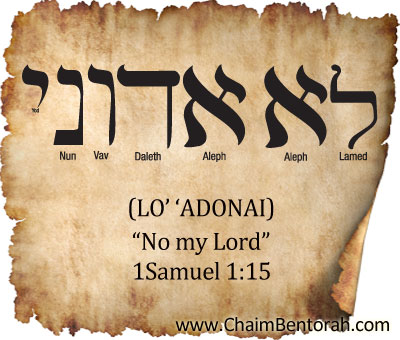
HEBREW WORD STUDY – NO MY LORD – LO’ ‘ADONAI לא אדוני Lamed Aleph Aleph Daleth Vav Nun Yod
1Samuel 1:15: “And Hannah answered and said, No, my lord, I [am] a woman of a sorrowful spirit: I have drunk neither wine nor strong drink, but have poured out my soul before the LORD.”
I Corinthians 14:33-34: “For God is not [the author] of confusion, but of peace, as in all churches of the saints. (34) Let your women keep silence in the churches: for it is not permitted unto them to speak; but [they are commanded] to be under obedience, as also saith the law.”
The Southern Baptist take this verse literally. I read this morning where the Southern Baptist Convention will excommunicate any congregation that has a woman preacher. One argument, aside from an alleged Biblical argument by Paul is that the Orthodox Jewish synagogue excludes women from their services and only men pray and worship in the Synagogue.
Did the Jews traditional consider women inferior to men? Not hardly, in fact far from it. Jews learned how to pray from a woman named Hannah who lived 3,000 years ago found in the Book of I Samuel. She wept before the Lord in the temple pleading for a child. Along comes this High Priest Eli, a man who is to be the most holy man in Israel, steeped in the Divine mysteries of the Temple whose Great Grandfather was Aaron and he mistakes this ultimate prayer, a prayer where this woman is pouring her heart out to God in tears, he mistakes it for drunkenness. Our whole model of prayer as it is in Judaism is a feminine thing, men don’t like to cry, don’t like to appear helpless or express their inner selves. On top of that men do not do it when women are around, so women were separated to allow men greater freedom to pray. In the Semitic mindset, women rule when it comes to prayer. How about worship? Well, when the children of Israel crossed the Red Sea, the men sang but it was the women who played cymbals and danced. Again, in worship, women ruled. In the Song of Solomon, it is the woman’s voice that predominates the book. The indwelling presence of God is called the Shechinah which is a feminine element. God invests Himself in His creation to give it life and He passed that honor unto women. The word for mountain is har. If you put it in a feminine form it is harah which means a pregnant woman. Last Tuesday we studied Word Plays in our Hebrew 101 class. Harah is a play off the word har, not because a pregnant woman is big like a mountain, but because God manifested Himself on top of a mountain, Mt.Sinai, and the closer you came to the top the closer you came to God. A pregnant woman was considered very close to God for God was forming a life inside her. Because God forms life inside a woman a woman was considered to have special knowledge of God a holiness within themselves alone which men could only achieve in a minyan, a group of ten.
Women tend to let their emotions dominate them. Men follow more with their mind than their emotions. This creates a balance in the physical world. Yet, there is a danger of going too far with order and too far with the disorder. A man and woman are to work together for a balance. Yes, you need order in running the business of the church. Men were passing that job onto women in Paul’s day and the women were at each other’s throats over whether to have black olives or green olives for the fellowship dinner. (I actually witnessed that when I was a pastor).
I don’t think Paul was addressing the worship service in I Corinthians. He was addressing the business aspect of the church. The churches followed the synagogue model where women were kept separate from the men so men could freely express themselves to God which, as I said earlier, they were not prone to do when women were around. On top of, that it was believed that women had a special knowledge of God because they were to spend their time raising children and could not spend the time men did in studying Torah. Yet women were respected for their knowledge. According to an article I read by an orthodox rabbi this is clearly played out in the story of Hannah.
When the High Priest Eli accused her of drunkenness she said; “Lo Adonai” – No my lord. Can you imagine saying something like that to the Pope? You would have to go through a dozen diplomatic channels to correct the Pope, if you even got that far. Here is a common woman declaring to the High Priest of God that he is wrong, how insolent can you get. Yet, here is the kicker, he not only believed her but basically admitted he wrong by blessing her. A man would never get away with that. This High Priest respected this woman because he understood she had a relationship with God that was much different than his.
If you closely examine the culture of the first century, the culture of Semitic women and the nature of Judaism itself, you will get a different understanding of I Corinthians. You will find that women are not considered inferior but would be much better at running worship and praise than organizing the Saturday pot luck.
STAY IN THE LOOP
Subscribe to our free newsletter.
Leave A Comment
Hebrew Word Study – A Passion – B’ir – Beth Ayin Yod Resh Song of Solomon 3:3, “The watchmen that go about the city found me: Saw ye him who my soul loveth?” “Ich bin ein Berliner” John F. Kennedy, June 26. 1963. Translation, “I am a jelly filled donut.” There is an urban legend
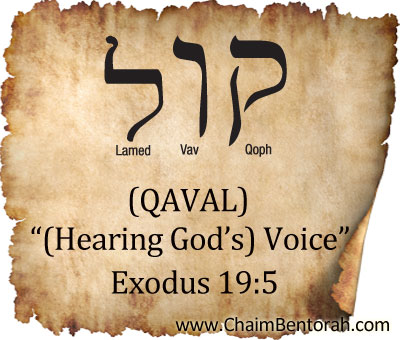
HEBREW WORD STUDY – (HEARING GOD’S) VOICE – QAVAL קול Exodus 19:5: Now therefore if you will obey my voice indeed and keep my commandments, Then you will be a peculiar treasure unto me above all the people, for all the earth is mine.” What caught my attention in this verse is the thought that
-
Hebrew Word Study – A Sensitive Nature – Pathah – Pei Taw Hei פתה Psalms 116:6: “The Lord preserves the simple, I was brought low and He helped me.” Hebrew Word Study – A Sensitive Nature – Pathah – Pei Taw Hei Psalms 116:6: “The Lord preserves the simple, I was brought low and He
WORD STUDY – ABBA אבא Mark 14:35-36: “And he went forward a little, and fell on the ground, and prayed that, if it were possible, the hour might pass from him. And he said, Abba, Father, all things are possible unto thee; take away this cup from me: nevertheless not what I will, but what