
by admin
Share
by admin
Share
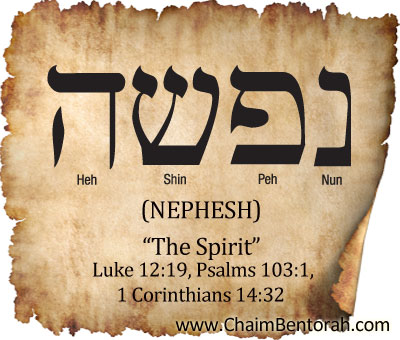
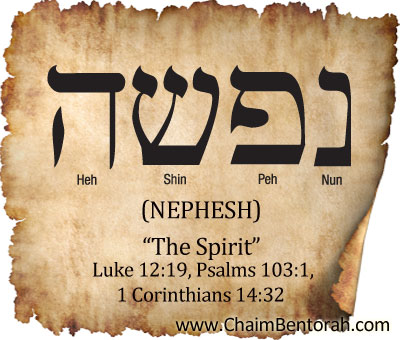
HEBREW WORD STUDY – THE SPIRIT – NEPHESH נפשה
Luke 12:19: “And I will say to my soul, Soul, thou hast much goods laid up for many years; take thine ease, eat, drink, [and] be merry”.
Psalms 103:1 “A Psalm of David. Bless the LORD, O my soul: and all that is within me, [bless] his holy name.”
1 Corinthians 14:32: “And the spirits of the prophets are subject to the prophets.”
 Let me start off by saying I am not a theologian. What I am giving you here is just one of many possible answers or understandings. Many will disagree with my position and rightly so. I based this on my own personal bias, relationship with God and understanding of God. This topic has been debated for over 2,000 years by some of the greatest minds to walk the earth and they have not agreed so it is very unlikely this poor slob will come up with the definitive answer, but it works for me so here goes.
The Bible talks about the heart of man, the soul of man, the S(s)spirit of man, the body of man and the mind of man. Let’s see that makes about five parts to man. What part ends up in heaven or hell after we die? That is where the fun begins and where no one has a definite answer even though they may say they do.
Most theologians narrow this down to just body, soul and spirit with the mind and heart belonging to one or all of these. I will not relate all the views, you can find that online if you are so interesting. I only want to relate my view as it helps me understand Luke 12:19.
In Luke 12 Jesus tells a story of a man who had a wonderful harvest and with this windfall plans his retirement. He builds storehouses to store his crop and tells his soul to eat, drink and be merry and enjoy the good life. But that night God calls him a fool and says that his soul will be required of him. The word required in Aramaic is tava’ which means to make an accounting.
The Greek and the Aramaic are pretty compatible here so I will just deal with the Aramaic. In the Aramaic, the word used for the soul is nephesh like in the Hebrew and the same word used in Psalms 103 when David commands his soul to bless the Lord. When God created man in a physical body (an adamah) from the dust of the ground, he breathed the breath the nephesh of life into man’s nostrils and man became a living nephesh. This nephesh is what gives the physical body life. Somewhere along the line man receives a spirit or a rauch. That is where Scripture is silent and that is what causes so much speculation. You have the trichotomist or tripartite view which says man has three distinct components, body, soul and spirit and the dichotomist or bipartite who say man has only two components body with soul and spirit as the same entity or the body and soul as the same entity, but with different terms. I am not sure where I stand on that, which is pretty much what I discern from reading the Talmud, the sages were divided on this issue as well.
However, I was reading in the Talmud Shabbat 152b and the Ecclesiastes Rabbah 12:7 something very interesting. When God breathed the breath of life the nephesh into man he also breathed the spirit rauch into man. The soul and body were the non-eternal part of man which extinguishes at the time of death and the spirit is what lives on. The spirit was given to man in purity and was joined with the pure soul or life of man. However, the soul had a free will and when it sinned it corrupted the spirit. This is a problem because it is the spirit to which God joins His Spirit and communicates and communes with man. But when our spirits were corrupted by our self-willed soul, God could not join with man. How could the purity of the spirit be corrupted? Not sure, but the Apostle Paul does say in I Corinthians 14:32 that the prophets had control of their spirits – rauch. If the prophets have control so do we and we call our spirits to join our soul in its corruption.
This is where Paul talks of the battle of the flesh which is really a battle of the spirit between the body, soul against the spirit. I believe this gives us an interesting take on the story Jesus told of the rich man in Luke. Wealth in those days was determined by how secure your food supply was. Among the Hebrews, those who had a good harvest were expected to share with those who had a bad harvest so no one would starve during lean times. This man did not share and in fact, he spoke to his soul. Yes, ancient Jews believe you could speak to your soul, you could order your soul as David did in Psalms 103:1 to get with the program and bless God. I believe Jesus was teaching that we must continually be commanding our souls to put spiritual things first so that the soul does not corrupt our spirit. This man told his soul to ignore the spiritual and just enjoy the good life of the flesh.
The blood of Jesus covers the corruption that the soul does to our spirits so when our soul or life-giving force stops giving the body life, the spirit will be able to join God’s spirit. But if someone does not accept the gift of the blood of Jesus and dies with a corrupted soul, his spirit ain’t going to be with God but will go where that corruption is accepted.
Paul talks about a war between our corrupted souls (life/body) and our spirit (eternal spiritual component). Sort of like my grandfather used to tell the story of the old man who because a Christian, that is accepted the blood of Jesus to purify his spirit. When someone asked him what it was like he said like two dogs inside of me fighting, one good (his spirit) and one evil (his corrupted soul). When asked which one wins? He said: “The one I feed the most.”
I know this theory has lots of holes, but it works for me.

STAY IN THE LOOP
Subscribe to our free newsletter.
Leave A Comment
Hebrew Word Study – A Passion – B’ir – Beth Ayin Yod Resh Song of Solomon 3:3, “The watchmen that go about the city found me: Saw ye him who my soul loveth?” “Ich bin ein Berliner” John F. Kennedy, June 26. 1963. Translation, “I am a jelly filled donut.” There is an urban legend

HEBREW WORD STUDY – (HEARING GOD’S) VOICE – QAVAL קול Exodus 19:5: Now therefore if you will obey my voice indeed and keep my commandments, Then you will be a peculiar treasure unto me above all the people, for all the earth is mine.” What caught my attention in this verse is the thought that
-
Hebrew Word Study – A Sensitive Nature – Pathah – Pei Taw Hei פתה Psalms 116:6: “The Lord preserves the simple, I was brought low and He helped me.” Hebrew Word Study – A Sensitive Nature – Pathah – Pei Taw Hei Psalms 116:6: “The Lord preserves the simple, I was brought low and He
WORD STUDY – ABBA אבא Mark 14:35-36: “And he went forward a little, and fell on the ground, and prayed that, if it were possible, the hour might pass from him. And he said, Abba, Father, all things are possible unto thee; take away this cup from me: nevertheless not what I will, but what