
by admin
Share
by admin
Share
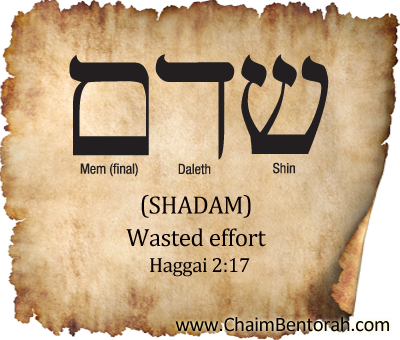
HEBREW WORD STUDY – WASTED EFFORT – SHADAM – שדם Shin Daleth Mem
Haggai 2:17: “I smote you with blasting and with mildew and with hail in all the labors of your hands; yet you turned not to me, saith the Lord?”
The Book of Haggai is an often overlooked book of the Bible, probably because it is only two chapters. Haggai was the first of the three post exilic prophets. The others were Zechariah who lived the same time Haggai did and Malachi who lived about 100 years after Haggai. It is believed that Haggai was taken captive to Babylon by Nebuchadnezzar when he was a child. He began his ministry about 16 years after the return of the Jews to Judah to rebuild the temple.
Haggai came to the scene when the work on rebuilding the temple came to a halt due to the Samaritans raiding the Hebrew’s crops while they were trying to rebuild the temple. The harassment was so great that the people gave up on the temple and for 18 years just focus on making a living and restoring their economy. The only problem is that during those 18 years things got worse and they ended up in famine.
Think about it for a moment. Did God ever call you to do something and you started off with great enthusiasm but then when resistance came along or your livelihood was threatened, you gave up. 18 years go by and still, you have your tale tucked behind you, thinking about completing your mission to God – some day when you get a good retirement under your belt.
Well, here is Haggai with a word for you. “Get moving.” In fact he is attributing the current famine in the land due to the failure of the people to carry out God’s desire. “I smote you with blasting…”
The word smote is “nakah” which is a sudden striking down. This is in a Hiphil form so God has brought about some situation that caused a “blasting.” In the Hebrew, it is “shadam.” This is a wasted or worthless cornfield or vineyard. In other words, God caused a sudden wasting of the cornfields and vineyards. This may be a reference to the harassment of the Samaritans who would ransack their cornfields and vineyards to keep the people from rebuilding the temple and hopefully discourage them to the point where they would return to Persia. The word “shadam” is built on the word “dam” which means “blood.” The “shin” represents corruption or destruction. In other words, God causes destruction or corruption of their life’s source, their crops, their economy. Basically, God is saying that He brought about the sudden destruction of their economy, not the Samaritans. He brought it about because they abandoned His calling.
Would you like Chaim Bentorah as your personal Hebrew teacher?
|
|
He also smote them with hail which, even today, will destroy an entire crop of corn or grain. He also sent mildew. Mildew is “yaraq” which is a pale greenish color and is felt by some scholars to refer to a disease that afflicts corn and other types of grain. I mean Israel’s poor corn and grain crop did not stand a chance. What the Samaritans did not ransack, hail took out and what was left from that was struck with a disease. In America, we could lose a crop of corn from a hail storm in Kansas, but we still have corn in Illinois, but that could get hit with a disease and the corn in Iowa could get wiped out by bandits in the commodities market as it did during the Great Depression.
The prophet concludes by saying “in all the labors of your hand.” What you work so hard for, your entire savings, your retirement funds, God can wipe it out in one swift blow. You see the people were trying to rebuild the temple and make a living at the same time. When problems arose they focused on making a living and put the work of the temple on hold until they improved their economic condition, but Haggai was saying: “Hey, gang, look, your economics will be wiped out by plague, bandits, and storms whether you’re working on the temple or not. At least if you continued to work on the temple, you would have been getting God’s work accomplished. Now look, nothing is accomplished.
That last phrase is a little disturbing: “Yet you turned not to Me.” The word translated as “turn” is literally in the Hebrew “with you” or “in company with you.” Quite literally this phrase reads: “And yet you did not walk in company with me.” That was the problem, not their ceasing to build the temple but their ceasing to walk hand in hand with God. It is sort of a picture of God and the people building the temple together, and suddenly God looks over His shoulder and sees everyone is gone and He is left alone.
With the pandemic, the elections, the economy suffering and many losing their jobs it is very hard to focus on God. On top of that in many parts of the country churches are limited in the number of people who can attend. You can’t even get relief in attending a local fellowship. But these are the times to walk hand in hand with God, these are the time when you seek His kingdom first and let everything else be added unto you.
Like Elijah when I look out in the distance I see a small cloud the size of a man’s fist. There is a rainstorm approaching. That is a good sign, rain brings nourishment to crops and livestock. Rain brings life. Rain can also bring flooding and damage. This coming storm will be a blessing or a curse. It could be a blessing of bringing the life of Jesus Christ to this nation that is thirsty for God. But we can choose to make it curse and it will bring destruction to our Christian way of life. It is your choice, you can run and hide and suffer the consequences or you can continue to serve God as boldly as you can and you can just smile at the rainstorms.
Hi there! Thank you for reading this Daily Word Study. Can I ask a favor? Share this Daily Word Study with your friends on Facebook and Twitter by clicking one of the icons below.
Thanks & Blessings, it means a lot to me!
STAY IN THE LOOP
Subscribe to our free newsletter.
Leave A Comment
Hebrew Word Study – A Passion – B’ir – Beth Ayin Yod Resh Song of Solomon 3:3, “The watchmen that go about the city found me: Saw ye him who my soul loveth?” “Ich bin ein Berliner” John F. Kennedy, June 26. 1963. Translation, “I am a jelly filled donut.” There is an urban legend

HEBREW WORD STUDY – (HEARING GOD’S) VOICE – QAVAL קול Exodus 19:5: Now therefore if you will obey my voice indeed and keep my commandments, Then you will be a peculiar treasure unto me above all the people, for all the earth is mine.” What caught my attention in this verse is the thought that
-
Hebrew Word Study – A Sensitive Nature – Pathah – Pei Taw Hei פתה Psalms 116:6: “The Lord preserves the simple, I was brought low and He helped me.” Hebrew Word Study – A Sensitive Nature – Pathah – Pei Taw Hei Psalms 116:6: “The Lord preserves the simple, I was brought low and He
WORD STUDY – ABBA אבא Mark 14:35-36: “And he went forward a little, and fell on the ground, and prayed that, if it were possible, the hour might pass from him. And he said, Abba, Father, all things are possible unto thee; take away this cup from me: nevertheless not what I will, but what